Just back from Wednesday’s Capitol Hill press conference spotlighting the introduction of House Resolution 14, which urges the president to declassify a 28-page finding on specific sources of foreign government support of the 9/11 hijackers, 28Pages.org director Brian McGlinchey appeared on the Scott Horton Show yesterday to discuss indications of Saudi support of the 9/11 hijackers, the 28 pages and how individual citizens can help those on Capitol Hill who are pushing for their release.
The movement to declassify a finding on foreign government support of the 9/11 hijackers might be strengthened soon: A federal panel is reviewing the censored 28-page chapter of the report of a Congressional joint inquiry into 9/11 and is expected to make a recommendation to President Obama in the coming months.
Attorney Tom Julin: Making the Case for 28 Pages Transparency
The review of the redacted chapter on sources of foreign support of the September 11 terrorists is being conducted under a process called Mandatory Declassification Review (MDR), and was initiated by attorney Tom Julin on behalf of Dan Christensen, Anthony Summers and Robbyn Swan. Christensen is the editor of FloridaBulldog.org, and has been working to learn what the FBI knows about a 9/11 cell in Sarasota; Summers and Swan are investigative journalists and authors of the Pulitzer Prize-finalist The Eleventh Day: The Full Story of 9/11.
Understanding the MDR Process
MDR is a multi-tiered process that begins with a request to an agency to review a specific classified document and consider releasing it. It was created by an executive order issued by President Clinton, and can now be found in Executive Order 13526 (see Sec. 3.5).
The 28 pages request was directed to the Department of Justice, which failed to respond within the deadline imposed by the process. Ultimately, Julin appealed to the Interagency Security Classification Appeals Panel, or ISCAP. The highest authority in the MDR process, ISCAP agreed to review the 28 pages for declassification. At a Nov. 11 event, Julin said he’d been told to expect the panel’s recommendation to President Obama sometime this winter.
A few weeks before that event, nine members of Congress who’ve read the censored chapter sent a letter to ISCAP urging their release, saying “we firmly believe that declassification of the 28 pages would enhance, not harm, U.S. national security interests.”
Under the rules governing the ISCAP review, a recommendation to declassify a document “requires the affirmative vote of at least a majority of the members present.” The panel consists of senior level representatives appointed by:
The Department of State
The Department of Defense
The Department of Justice
The National Archives
The Office of the Director of National Intelligence
The National Security Advisor
In addition, the director of the CIA can opt to appoint a voting member to the panel where information that originated with the CIA is in question.
Anticipating the Verdict
Eyeing the ISCAP “jury box” and contemplating the governmental constituencies each member represents, it’s far from certain the panel will side with so many authoritative figures on the 28 pages and acknowledge there’s no national security justification for the blanket redaction of this entire chapter of the congressional joint inquiry’s report.
And even if the panel does reach the same conclusion of the chairs of the 9/11 Commission and the Senate co-chairs of the joint inquiry, it’s important to emphasize that the word “mandatory” in the name of the process refers to the review and not to the declassification—the panel’s verdict is but a recommendation to the president, one may be accompanied by a final, urgent appeal for secrecy from a government agency. It would, however, be the most powerful such recommendation to date, one that would add substantial pressure on the president to honor the commitment he made to 9/11 family members and release the 28 pages—while further eroding the credibility of those who say they must remain secret.
The Mandatory Declassification Review is a very important and intriguing front in the fight to finally release the 28 pages, but it’s not the only one: If you want to know what’s in the 28 pages, it’s critical that you make your voice heard on this issue from Capitol Hill to the White House—right now, while you’re thinking about it.
Add your voice to the growing, bipartisan movement to declassify the 28 pages.
Join the movement by following 28Pages.org on Twitter and Facebook.
Demonstrating that the declassification of a 28-page finding on foreign government aid to the 9/11 hijackers remains one of their highest priorities as the new Congress convenes, Congressmen Walter Jones and Stephen Lynch and former Senator Bob Graham will host a press conference in Washington on Wednesday, January 7 at 9:30 am.
The event will serve to draw attention to House Resolution 14, which, if passed, would urge the president to declassify the 28 pages. Jones, Lynch and Congressman Thomas Massie will introduce HRes14, which is a successor to HRes 428, into the 114th Congress. Originally introduced in December, 2013, HRes 428 garnered a highly bipartisan mix of 21 cosponsors in its first year. In a sign of the resolution’s momentum, more than half of those cosponsors signed on in just the last four months of 2014.
Past press conferences on the 28 pages have produced some very impactful moments, including Massie’s description of the “disturbing” experience of reading the redacted material and 9/11 parent Matt Sellitto’s impassioned and pointed criticism of Obama: “Mr. President, I call you a liar.”
Graham served as a co-chair of the joint Congressional inquiry that produced the report that contains the 28 pages and has been an ardent advocate of their release. He has also helped efforts by BrowardBulldog.org to learn more about what the FBI knew about terror cells in Sarasota and elsewhere. Graham has said that George W. Bush’s classification of the 28 pages—and the continuation of that secrecy by the Obama administration—helped enable the rise of ISIS.
Graham’s thoughts on the issue may hold extra sway with one particular incoming freshman member of Congress: his daughter, Gwen Graham, will be sworn in on Tuesday.
September 11 family members will be in attendance, including representatives from 9/11 Families United for Justice Against Terrorism. The press conference will be held in Room 121 of the Cannon House Office Building.
Help Congressmen Jones, Lynch and Massie build HRes 14 cosponsorship: Call or write your representative today.
Today, Congressmen Walter Jones and Stephen Lynch are laboring to win a Senate ally or two to join them in pressing for the release of the classified, 28-page finding on foreign government support of the 9/11 hijackers.
In 2003, no fewer than 46 senators signed a letter to President George W. Bush urging him to reverse his decision to classify those pages, which constituted an entire section of the report of the joint Congressional inquiry into 9/11.
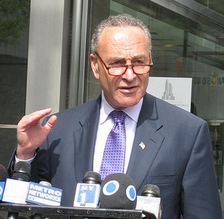
Senator Chuck Schumer
The 2003 letter-signing effort was led by New York Senator Chuck Schumer, who persuaded 43 of fellow Democrats to join him, along with Republican Sam Brownback and independent Jim Jeffords. (For a complete list of signers, see below.)
If just five more senators had stood up for 9/11 transparency, the Senate would have had the 51 votes needed to declassify the 28 pages by itself, even over Bush’s objection.
Speaking forcefully at the time, Schumer said, “The bottom line is that keeping this material classified only strengthens the theory that some in the U.S. government are hellbent on covering up for the Saudis. If we’re going to take terrorism down, that kind of behavior has got to be nipped in the bud and shedding some light on these 28 pages would start that process.”
Senators: Secrecy Prevents Public Penalty for Supporting Terror
In part, the August 1, 2003 letter to Bush read:
“According to the Joint Inquiry report, the content of the redacted pages detail ‘specific sources of foreign support for some of the September 11th hijackers while they were in the United States.’ Unfortunately, because all but two pages of the entire section have been deemed too secret for public disclosure, the American people remain in the dark about other countries that may have facilitated the terrorist attacks.
It has been widely reported in the press that the foreign sources referred to in this portion of the Joint Inquiry analysis reside primarily in Saudi Arabia. The decision to classify this information sends the wrong message to the American people about our nation’s anti-terror effort and makes it seem as if there will be no penalty for foreign abettors of the hijackers…Protecting the Saudi regime by eliminating any public penalty for the support given to terrorists from within its borders would be a mistake.”
The letter is more than a study in history: As Congressmen Jones and Lynch scour the Senate for counterparts willing to introduce a resolution similar to their own HRes 428—which urges the president to declassify the 28 pages—those who signed the 2003 letter would seem to be prime candidates.
When the new Senate convenes in January, 12 of those 46 signatories will still be in office, all Democrats. In order of seniority, they are: Patrick Leahy (VT), Barbara Mikulski (MD), Harry Reid (NV), Barbara Boxer (CA), Patty Murray (WA), Ron Wyden (OR), Dick Durbin (IL), Jack Reed (RI), Chuck Schumer (NY), Bill Nelson (FL), Tom Carper (DE) and Maria Cantwell (WA).
The 2003 Letter: A Matter of Principle…or Party?
Given his leadership on the issue in 2003, one would expect Schumer to be more than happy to introduce a non-binding Senate resolution pressing Obama to release the 28 pages. However, despite his history on the issue and his current sponsorship of legislation that would clear the path for lawsuits against state sponsors of 9/11 terror, Schumer has yet to join forces with Jones, Lynch and other House supporters of 28-pages transparency.
Schumer’s silence on the 28 pages prompts a question: Is he reluctant to publicly hold a Democratic president to the same standard he once held a Republican one? If so, he should note that party lines aren’t evident in the House’s drive to declassify the 28 pages—the list of cosponsors of HRes 428 is a near-perfect split of Democrats and Republicans.
Secretary of State John Kerry: One of 46 Senators Urging Release of 28 Pages
The question of principled consistency among the signers of the 2003 letter is underscored in a different way by the presence of three notable signatures: Joe Biden, Hillary Clinton and John Kerry—Obama’s vice president and his past and present secretaries of state—each urged Bush to release the 28 pages.
And yet, despite the claimed convictions of three of his administration’s most senior officials and the fact that Obama himself reportedly assured 9/11 family members that he’d release the 28 pages, he continues to guard whatever secrets the Bush administration wanted buried.
Complete List of Signatories
28Pages.org obtained a copy of the 2003 letter, but we couldn’t find an authoritative list of the signers—so we built one ourselves. Some of the signatures are easy to read, but deciphering the rest required cross-referencing a list of who was in the Senate in 2003 and then comparing the signatures on the letter to known samples posted in various places on the web. Here’s the full list, organized as they are on the letter.
First Page: Charles Schumer, Sam Brownback
Second Page, Left Column: Jon Corzine, Maria Cantwell, Harry Reid, Max Baucus, Ron Wyden, Russ Feingold, Mary Landrieu, Jack Reed, Patty Murray
Second Page, Right Column: Tom Daschle, Joe Lieberman, Mark Dayton, Joe Biden, Christopher Dodd, Carl Levin, Tom Carper, Byron Dorgan, Bill Nelson
Third Page, Left Column: Daniel Akaka, Bob Graham, Patrick Leahy, Barbara Boxer, Jim Jeffords, Barbara Mikulski, Tim Johnson, Jeff Bingaman, Evan Bayh
Third Page, Right Column: Dick Durbin, Tom Harkin, Frank Lautenberg, Ben Nelson, Fritz Hollings, Paul Sarbanes, Debbie Stabenow, John Breaux, Blanche Lincoln
Last Page: Hillary Clinton, Mark Pryor, John Edwards, Herb Kohl, Daniel Inouye, Ted Kennedy, John Kerry, Robert Byrd
The only four Democrats who did not sign the letter were Dianne Feinstein, Jay Rockefeller, Zell Miller and Kent Conrad. Republicans Richard Shelby and Olympia Snowe had previously supported the declassification of the 28 pages but did not sign the letter.
According to a Dan Christensen story published today at Broward Bulldog, the House Intelligence Committee has refused Florida Democratic Congressman Alan Grayson’s request to read the classified 28-page finding on foreign government support of the 9/11 hijackers.
This is the first refusal of a request to read the 28 pages that 28Pages.org is aware of and—given Congress’ role in overseeing national defense and counter-terror policy—it’s a troubling development. According to the Broward Bulldog report, Grayson’s request was denied on Dec. 1 in an 8-4 vote that fell directly down party lines, with the GOP prevailing.
Grayson told the Bulldog the refusal was orchestrated by outgoing committee chair Mike Rogers, who is leaving the House and launching a career in radio. He said the action was retribution for his criticism of the federal government’s mass surveillance programs:
“Why was I denied? I have been instrumental in publicizing the Snowden revelations regarding pervasive domestic spying by the government and this is a petty means for the spying industrial complex to lash back,” Grayson said last week, referring to National Security Agency leaker Edward Snowden.
Though the House Intelligence Committee is charged with overseeing the country’s spy agencies, Rogers has been frequently accused of instead serving as their unconditional—and, at times, dishonest—public defender. It’s also worth noting that Rogers is a former FBI agent, and the contents of the 28 pages may be every bit as embarrassing to the FBI, CIA and NSA as they are to Bush administration officials, Saudi Arabia and other countries with ties to the 9/11 hijackers.
Echoing charges of deception leveled against Rogers in other places, Grayson accused Rogers of misleading committee members ahead of the vote:
“Congressman Rogers made serious misrepresentations to other committee members when he brought this up,” Grayson said in a telephone interview. “When the Guardian reported on the fact that there was universal domestic surveillance regarding every single phone call, including this one, I went to the floor of the House and gave a lengthy speech decrying it.”
“Chairman Rogers told the committee that I had discussed classified information on the floor. He left out the most important part that I was discussing what was reported in the newspaper,” said Grayson. “He clearly misled the committee for an improper purpose: to deny a sitting member of Congress important classified information necessary for me to do my job.”
Hopefully, the committee’s refusal of permission will—by drawing attention to the redacted 28-page passage found in the report of a joint Congressional inquiry into 9/11—prompt other House members to seek permission themselves.
Read Christensen’s entire story here, then watch him describe the FBI’s stonewalling of his research into the agency’s investigation of a 9/11 cell in Sarasota.
Encourage your own House rep to read the 28 pages. Make a quick phone call or send a letter we’ve drafted for you.





 28Pages.org