Jeb Bush: “I Don’t Know What the 28 Pages Are”

By Brian McGlinchey

Jeb Bush
Jeb Bush

Activists affiliated with New Hampshire-based “Declassify the 28 Pages” are at it again.

Continuing to make the redacted 28 pages on foreign government support of the 9/11 hijackers a campaign issue, they recently asked Republican presidential candidate Jeb Bush if he would declassify them.

Bush’s answer: “I don’t know what the 28 pages are, so please explain it.” (Video below.)

The exchange took place at an August 7 town hall in Barrington, New Hampshire. Bush added, “Look, I can’t commit to something until I see it. Since I don’t have classified information, I can’t tell you what it is or tell you whether it should be declassified.” When the woman offered to explain what the 28 pages are—as Bush himself had asked in his initial reply—he stopped her from doing so.

There are two potential explanations for Bush’s answer, and neither is flattering to the former Florida governor. Bush is either so poorly informed on national security matters that he is truly unaware of a well-documented and intriguing 13-year old controversy surrounding his brother’s decision to classify a full chapter in the report of a 2002 joint congressional inquiry into September 11, or he was feigning ignorance to dodge discussion of yet another sensitive Bush family topic.

Jeb’s Links to the 28 Pages: Family, Florida and Saudi Arabia

There are many reasons why Bush’s claim of ignorance on this topic invites skepticism. First, of course, is the fact that his brother sits at the center of the controversy.

Then there’s the fact that, for more than a dozen years, the most prominent voice calling for the declassification of the 28 pages has been Bush’s fellow Floridian Bob Graham. While Bush was governor, Graham represented Florida in the Senate and co-chaired the unprecedented joint inquiry that produced the 28 pages. When the 28 pages were released, Graham publicly decried the redaction and was among 46 senators who signed a letter to Jeb’s brother urging their release.

Also during their governor-senator overlap, Graham published “Intelligence Matters,” a book that was very critical of the Bush administration’s actions before and after the September 11 attacks, including the decision to redact the 28 pages.

Among the criticisms advanced by Graham were well-substantiated claims that the Bush White House went out of its way to shield the Kingdom of Saudi Arabia from scrutiny of its ties to the 9/11 hijackers. Graham has since said the 28 pages “point a very strong finger at Saudi Arabia as being the principal financier” of the 9/11 attacks.
Screen shot 2015-08-19 at 1.59.12 PM
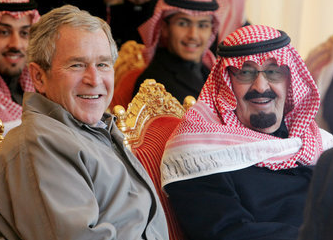
George W. Bush and King Abdullah bin Abd al-Aziz Al Saud

If the family and Florida connections to the 28 pages aren’t enough to put the issue on Bush’s radar, Graham’s claim that the 28 pages implicate Saudi Arabia in the devastating terror attack should be an attention-getter, given the Saudi royal family and the Bush family are deeply connected in ways that are both personal and financial.

$1.4 billion has reportedly made its way from the Saudi royal family to entities tied to the Bush family, and lobbyists for Saudi Arabia are helping to fund Bush’s 2016 presidential campaign. On the same day in February, two different lobbyists for Saudi Arabia gave a combined $15,000 to Bush’s super PAC, and one of them has already raised another $32,400 in bundled contributions for the Bush campaign fund.

Congressman Walter Jones—who has introduced a House resolution urging the release of the 28-pages chapter—has said, “There’s nothing in it about national security. It’s about the Bush Administration and its relationship with the Saudis.”

REDACTED w911Call Congress today—our guide makes it easy

Help us spread the word. Make a gift to 28Pages.org

With 28 Pages Still Hidden, Saudis May Be Released from 9/11 Suit

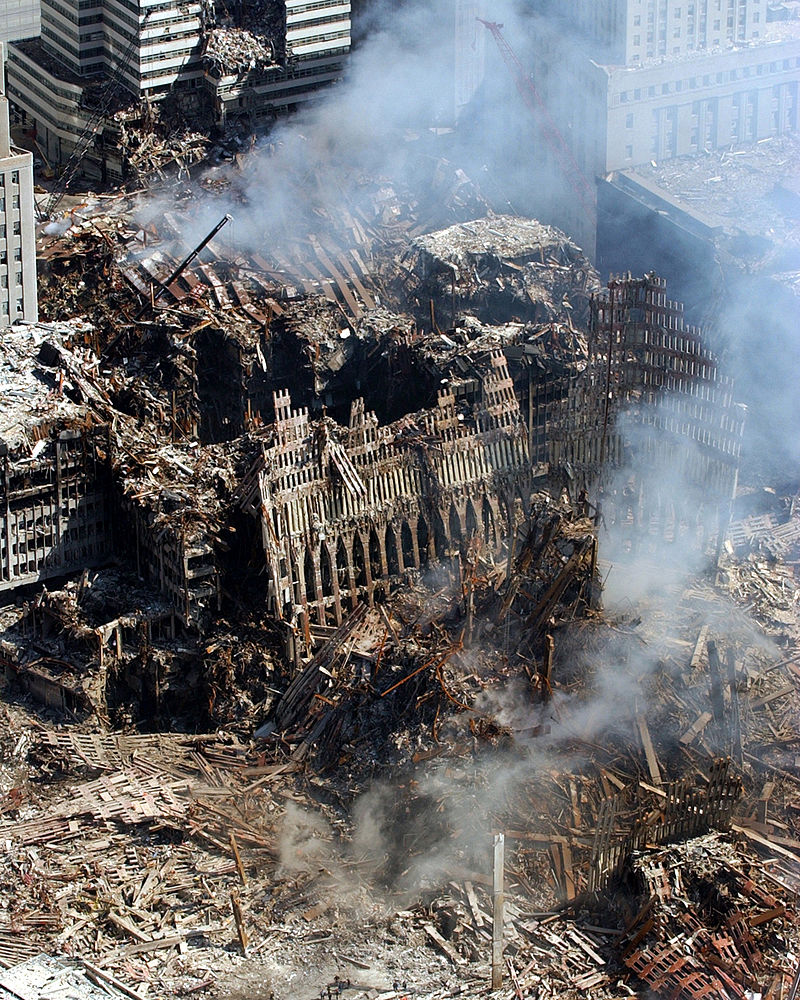
911 WTC aerial2

By Brian McGlinchey

Undermined by the U.S. government’s refusal to share everything it knows about the September 11 attacks, the pursuit of justice by 9/11 family members and survivors could be stopped in its tracks within the next 90 days.

In a courtroom just minutes from the World Trade Center, lawyers for the Kingdom of Saudi Arabia last Thursday asked Judge George Daniels to release the kingdom from a lawsuit seeking to hold it liable for aiding the 9/11 hijackers.

Representing Saudi Arabia, attorney Michael Kellogg said the victims have failed to provide “admissible, concrete, competent evidence” of Saudi Arabia’s complicity in the attacks.

Meanwhile, a 28-page chapter from a 2002 joint congressional intelligence inquiry that might tip the scales of justice in the plaintiffs’ favor remains out of reach, thanks to President Obama’s reluctance to declassify it.

Sean Carter, who represents the families and survivors, told New York’s PIX11 News, “The nature of Saudi support of al Qaeda remains classified at this point…it’s an issue that is featured in a whole range of intelligence documents…there is no real reason for them to be remain classified this many years out.”

Former Senator Bob Graham

The 28 pages detail specific sources of financial support for the hijackers and, according to former Senator Bob Graham, “point a very strong finger at Saudi Arabia as being the principal financier” of the attacks that killed 2,977 people. Graham and many others who’ve read the 28 pages insist there is no national security justification for the secrecy.

Saudi Arabia’s attorneys claim the 9/11 Commission Report exonerated the kingdom, a notion that’s refuted by, among others, commission member Bob Kerrey. In a sworn statement submitted for the suit last year, the former Nebraska senator wrote, “To the contrary, significant questions remain unanswered concerning the possible involvement of Saudi government institutions…and evidence relating to the plausible involvement of possible Saudi government agents in the September 11th attacks has never been fully pursued.”

The debate over the commission’s conclusion may be rendered moot with the release of the 28 pages: Congressman Walter Jones, who is leading the declassification drive in the House of Representatives, told the New Yorker “those 28 pages tell a story that has been completely removed from the 9/11 (Commission) Report.”

Will Judge Daniels “Connect the Dots”?

According to Michael D. Goldhaber, writing for The American Lawyer, Thursday’s courtroom exchanges emphasized a February 2000 meeting at the Saudi consulate in Los Angeles between alleged San Diego-based Saudi agent Omar al Bayoumi and embassy staffer Fahad al Thumairy. Plaintiffs attorneys and many observers point to that meeting as evidence of Saudi ties to the 9/11 plot.

Flight 77 Hijacker Nawaf al-Hazmi
Flight 77 Hijacker Nawaf al Hazmi

Immediately after the meeting, al Bayoumi went to a restaurant where he said he just happened to befriend 9/11 hijackers Nawaf al Hazmi and Khalid al Mihdhar, who had only days earlier arrived in the United States. (According to Graham’s book, “Intelligence Matters,” before leaving San Diego for Los Angeles that day, al Bayoumi told at least one person he was going to pick up visitors.)

Al Bayoumi proceeded to help the two move to San Diego, initially hosting them in his own home. He helped them find an apartment, paid their first two months rent and introduced them to a network of associates that included Anwar al Awlaki, who would become a prominent al Qaeda figure before dying in a U.S. drone strike in 2011.

Al Bayoumi’s wife served as a conduit for cashiers checks routed from a Saudi princess, and al Bayoumi himself received a dramatic, temporary raise at his no-show cover job coinciding with his generous sponsorship of the pair. On 9/11, al Hazmi and al Mihdhar hijacked American Airlines Flight 77, which hit the Pentagon.

Flight 77 Hijacker Khalid al Mihdhar

That mountain of circumstantial evidence, however, might not be enough to dissuade Judge Daniels from dropping Saudi Arabia from the suit. According to Goldhaber, Judge Daniels challenged the plaintiffs’ attorneys on exactly what was said at al Bayoumi’s meeting at the Saudi consulate, asking, “What’s the factual basis for you to allege that when al Thumairy met with al Bayoumi he said, ‘Give lodging to the hijackers, assist them and give financial support to the hijackers so that they can carry out the 9/11 attacks?’”

Summing the situation, Goldhaber writes, “The quest for historical truth threatens to founder on the judge’s futile desire for direct knowledge of espionage….This case ain’t going to trial against Saudi unless Judge Daniels is willing to connect the dots. The irony is that Daniels already entered a $6 billion default judgment against Iran on far weaker evidence.” (Indeed, even the word “evidence” seems too generous in the context of that case.)

Judge Daniels said he would render his decision within 90 days.

Heightened Urgency for Declassification Effort

Last summer, President Obama tasked the Office of the Director of National Intelligence (ODNI) to review the 28 pages for potential declassification. With a year passing since that order, and with the clock ticking on Judge Daniels’ self-imposed deadline, citizens, journalists and legislators should all be asking the White House one simple question: What’s taking so long?

Full transcript of July 30, 2015 hearing

Brian McGlinchey is the founder and director of 28Pages.org

REDACTED w911Help 9/11 families seek justice: Take action today

Please build awareness of the 28 pages by sharing this post with others

Lindsey Graham’s Admission: “I Have Not Read the 28 Pages”

By Brian McGlinchey

Senator Lindsey Graham

Republican presidential candidate and South Carolina Senator Lindsey Graham, who positions himself as one of Capitol Hill’s foremost champions of the “war on terror,” says he’s never read 28 classified pages detailing indications of foreign government support of the 9/11 hijackers.

Graham’s admission, which came at a July 10 town hall event in Goffstown, New Hampshire, was prompted by a prepared question from a member of the audience. In a recorded exchange posted to YouTube by “Declassify the 28,” Graham also expressed hesitation about releasing the 28 pages for fear of causing “damage” to Saudi Arabia.  (Video embedded below.)

28 Pages Said to Be Critical to Understanding Terror Threat

Since December 2013, Congressmen Walter Jones, Stephen Lynch and Thomas Massie have been urging legislators to read the 28-page chapter from a 2002 joint congressional intelligence inquiry. Jones says the 28 pages are “shocking,” and Lynch described them as critical to understanding “the web of intrigue…and the treacherous nature of the parties we are dealing with.” Massie said, “I had to stop every couple pages and try to rearrange my understanding of history.”

In light of those descriptions, Graham’s admitted failure to read the 28 pages could tarnish his foreign policy-dominated presidential campaign and make him vulnerable to being portrayed as neglectful of his duty to fully inform himself about America’s adversaries and their funding sources. (Senator Rand Paul has read the 28 pages and introduced Senate Bill 1471 to secure their release; it’s unknown if other members of the GOP candidate pool have read them.)

“Pretending to Be Informed”?

At a June press conference, Kentucky Congressman Massie lamented the fact that so many members of Congress are proposing counter-terror policies without the fuller understanding of terrorism that’s enabled by reading the 28 pages.

“Not a day goes by when we aren’t discussing how to prevent another 9/11…whether we should get involved in Syria, to what degree we should be concerned about Yemen, what to do about Iraq. ” Meanwhile, Massie said, “some of the best intelligence we have is in these 28 pages, and most of our colleagues…have not read them, yet they’re pretending to be informed on these issues.”

Graham, a member of the Senate armed services committee, has been among those most eager to propose U.S. military involvement to confront terrorism. For example, while most legislators shy away from the notion of recommitting combat troops to the Middle East, Graham has urged the deployment of 10,000 American ground troops to Iraq and Syria to battle ISIS.

Graham’s campaign website proclaims, “We need a president who understands the complex threats we face.” However, having not read the 28 pages, Graham may be advocating aggressive moves against the symptoms of Sunni extremism without a complete understanding of their cause. Indeed, former Florida Senator Bob Graham, who co-chaired the joint inquiry that produced the 28 pages, says the continued classification of the 28 pages enabled the rise of ISIS by shielding Saudi Arabian sponsors of the 9/11 terrorists from scrutiny and consequences.

Graham Protective of Saudi “Ally”

Noting Senator Bob Graham’s assertion that the 28 pages “point a strong finger at Saudi Arabia as the principal financier” of 9/11, the audience member asked Lindsey Graham if he would, as president, “do what Bush and Obama have failed to do” and declassify them.

Saudi FlagGraham said, “I will decide as to whether or not to release the pages based on what kind of damage it would do to our allies. Saudi Arabia is an ally that’s helped us with terrorism, but it’s a country that needs to change. Does that make sense?”

Reiterating the allegations of Saudi financial support of the 9/11 hijackers, the woman replied, “That doesn’t sound like an ally to me.”

Graham responded by outlining Saudi Arabia’s sponsorship of Wahabbi extremism as a bid to “buy tranquility” at home and said “one of the prices for admission” of Graham’s proposed military intervention against ISIS would be for Saudi Arabia to “stop funding these organizations. Stop funding terrorist groups. Stop double dealing.”

Graham’s claim that he would pressure Saudi Arabia as president seems at odds with his record in the senate. Though Graham is known for aggressive foreign policy positions against countries around the globe—including the use of economic sanctions and diplomatic isolation— 28Pages.org could find no record of his legislative leadership of a toughened stance toward Saudi Arabia.

To the contrary, Graham, in concert with fellow Senator John McCain, met with Saudi Prince Bandar bin Sultan to encourage the kingdom to finance Islamist extremist groups in Syria, a move that enabled the ascendance of the very ISIS threat that Graham now recommends deploying American servicemembers to fight.

Perhaps Graham’s posture would be far different if he’d read the 28 pages and had a fuller sense of Saudi Arabia’s apparent complicity in supporting the 9/11 hijackers. Or perhaps, more than 12 years since the 28 pages were written, he prefers not knowing what they reveal.

Brian McGlinchey is the founder and director of 28Pages.org

REDACTED w911Call 202-224-3121 today and ask your senator to cosponsor Senate Bill 1471

Follow 28Pages.org on Facebook and Twitter

Christie: Members of Congress Should Read 28 Pages on 9/11 Only “If They’re Interested”

Governor Chris Christie

Prospective presidential contender Chris Christie routinely accuses rivals of having “9/11 amnesia,” but is at peace with the fact that the vast majority of Congress is in a state of willful ignorance about indications of foreign government support of the 9/11 hijackers found in 28 classified pages of a 2002 congressional report.

At a Monday town hall in Goffstown, New Hampshire, a member of the audience provided a detailed overview of the 28 pages and why there’s a growing movement to declassify them.

She concluded by noting the fact that very few members of Congress have read them and asked the New Jersey governor if he felt people making life-and-death decisions should spend a half hour reading what Congressman Thomas Massie recently called “some of the best intelligence we have” in the war on terror.

“Different people in Congress are interested in different things,” said Christie. “If they have an interest, they should go and they should read it. I don’t know why they wouldn’t have an interest, but I’m not going to sit here and dictate to people what they spend their time on.” (Watch the full exchange on the embedded video below.)

It was quite a display of casual ambivalence from a politician who—like any other—routinely prescribes actions that others in government should take on countless issues, including many where human lives don’t hang in the balance.

When asked if the 28 pages should be declassified, Christie said, “It’s hard to argue when you don’t have the knowledge (of what’s in them).” All the more reason, it would seem, that Christie shouldn’t shy away from encouraging members of Congress to read the 28 pages and reach their own conclusions.

Deference to the President and the Intelligence Community

A Demonstrator Outside Christie's Town Hall
A Demonstrator Outside Christie’s New Hampshire Town Hall

Responding to former Senator Bob Graham’s assertion that the 28 pages implicate the Kingdom of Saudi Arabia, Christie—who had earlier in the town hall referred to Saudi Arabia as “our allies”—said, “The intelligence committees of the House and Senate are regularly briefed on all this stuff. I have a hard time believing that…direct evidence that puts something on a specific state actor could be kept secret on Capitol Hill for 13 years.”

The audience member pressed Christie, asking, “Don’t we have a right to know?”

He replied, “That’s for the President of the United States to decide…the question is: In his judgment and the judgment of the people in the national security apparatus, do they believe there’s something in there that’s classified that would cause harm or danger to American interests?”

Christie’s deference to the president and the intelligence community seemed to ignore the very real possibility that, in a country where excessive classification is well-documented, the 28 pages are being concealed for reasons that have nothing to do with national security.

Indeed, at a January press conference introducing H.Res.14, Graham said, “Much of what passes for classification for national security reasons is really classified because it would disclose incompetence. And since the people who are classifying are also often the subject of the materials, they have an institutional interest in avoiding exposure of their incompetence.”

28 Pages a Welcome Addition to Campaign Discourse

Earlier this year, the American Enterprise Institute’s Michael Rubin declared that the 28 pages should be a 2016 presidential campaign issue. Thanks to one knowledgeable and assertive citizen in New Hampshire—and the fact that top-tier contender Rand Paul is now championing the cause—that vision is starting to be realized.

REDACTED w911Help free the 28 pages: Call Congress today

Please help us build the movement: Follow us on Twitter and Facebook

Paul Offers NDAA Amendment to Drive Release of 28 Pages

Senator Rand Paul
Senator Rand Paul

Following through on intentions he announced earlier this week, Senator Rand Paul today offered an amendment to the pending National Defense Authorization Act (NDAA) that would require the president to declassify 28 pages on foreign government links to the 9/11 hijackers. The language is identical to S.1471, the bill Paul introduced on Monday with Senators Ron Wyden and Kirsten Gillibrand.

In a story on Paul’s new move, The Hill’s Julian Hattem said the proposed amendment (No. 1680) “heightens the profile of the fight and may increase the stakes for the opponents.”

Speaking via press release, Paul said, “For over 13 years, the family members of the victims of September 11, 2001 terrorist attacks have been deprived of the details surrounding the redacted 28 pages of the 9/11 Congressional Inquiry. I firmly believe the American people deserve a government that instills trust and a restoration of their sense of security, and think my amendment is a step in the right direction.”

Flushing Opponents of the 28 Pages Movement into Daylight

While there are a growing number of vocal champions of the declassification of the 28 pages, those who want the 28 pages kept under wraps have worked quietly and effectively out of public view.

As we wrote earlier this year, “It’s likely that among the most powerful of those unseen opponents of 9/11 transparency are two strange bedfellows: The Kingdom of Saudi Arabia—which has fueled the growth of terror, and the U.S. intelligence community—which is charged with thwarting terror.”

Paul’s amendment to the must-pass NDAA could force some of those opponents—and, more specifically, their Senate allies—out of the shadows.

In addition to Wyden and Gillibrand, there are 11 other senators who, if they are consistent on principle, should support Paul’s amendment. Senators Patrick Leahy (VT), Barbara Mikulski (MD), Harry Reid (NV), Barbara Boxer (CA), Patty Murray (WA), Dick Durbin (IL), Jack Reed (RI), Chuck Schumer (NY), Bill Nelson (FL), Tom Carper (DE) and Maria Cantwell (WA) each signed a 2003 letter asking then-President George W. Bush to release the 28 pages.

Similar 2003 Move Thwarted by McConnell

This isn’t the first time a senator has tried to elevate the 28 pages by way of an amendment to a bill. In October 2003, North Dakota Democrat Byron Dorgan offered an amendment to the Foreign Operations, Export Financing and Related Programs Appropriations Act, urging Bush to reverse his decision to redact the 28 pages.

Dorgan offered the amendment twice, but was thwarted on each attempt by then-GOP Senate Majority Whip Mitch McConnell, who objected and claimed that the amendment was not germane to the legislation. (For transcripts of that debate—which included a supporting speech from Senator Bob Graham—click here and here.)

McConnell, who is now Senate Majority Leader, recently engaged in a high-profile—yet cordial—parliamentary battle with Paul over the extension of the PATRIOT Act.

Where Dorgan’s “sense of the Senate” amendment would have urged the president to declassify the 28 pages, Paul’s language is more forceful. His amendment and bill each say that, not later than 60 days after the NDAA’s enactment, “the president shall declassify and release to the public the previously redacted portions” of the report of the joint intelligence inquiry where the 28 pages are found.

Protecting “Sources and Methods” or Preventing Embarrassment?

However, the language may also offer President Obama an opportunity to continue his administration’s refusal to release the 28 pages, as it says he is not required to declassify sources and methods if that release would “result in imminent lawless action or compromise presently on-going national security operations.”

Rep. Walter Jones
Rep. Walter Jones

In 2003, Bush invoked “sources and methods” when defending his decision to classify the pages, saying “Declassification of that part of a 900-page document would reveal sources and methods that would make it harder for us to win the war on terror. … It would help the enemy if they knew our sources and methods.”

Among many who have read the 28 pages, Congressman Walter Jones denies that declassification would harm national security in any way, pointing to other motives for the secrecy. “There’s nothing in it about national security. It’s about the Bush administration and its relationship with the Saudis,” Jones told The New Yorker.

REDACTED w911Call or write to Congress today

Please help us build the movement: Follow us on Twitter and Facebook