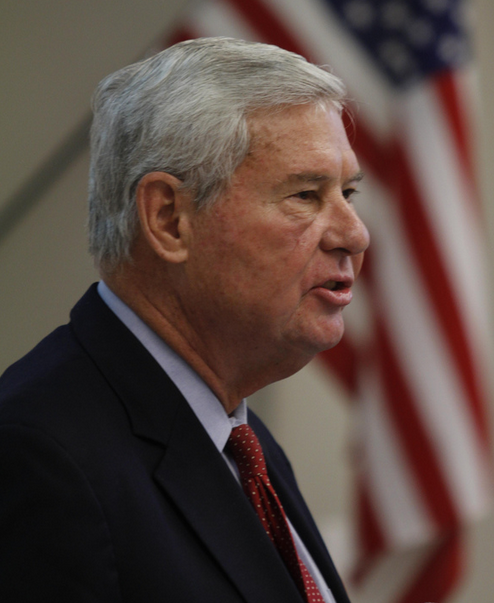
In New York Times Story on the 28 Pages, 9/11 Commission’s Zelikow Dismissive of Their Value

It’s been a week of heightened attention to links between Saudi Arabia and the 9/11 hijackers, first with the news that so-called “20th hijacker” Zacarias Moussaoui has testified that members of the Saudi royal family were major patrons of al Qaeda, and now with a front-page story from New York Times chief Washington correspondent Carl Hulse that discusses the classified, 28-page finding on foreign government links to the 9/11 hijackers found in the report of a joint congressional intelligence inquiry.
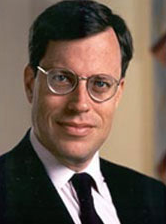
9/11 Executive Director Philip Zelikow

Read the piece here. As for our thoughts on the story, we’d like to focus on one specific aspect: The attempt by 9/11 Commission executive director Philip Zelikow to position the commission as having throughly investigated and then dismissed the Saudi Arabia leads uncovered by the congressional inquiry that preceded it. Writes Hulse:

Others familiar with that section of the report say that while it might implicate Saudi Arabia, the suspicions, investigatory leads and other findings it contains did not withstand deeper scrutiny. Philip D. Zelikow, the executive director of the national commission that investigated the Sept. 11 attacks after the congressional panels, said the commission followed up on the allegations, using some of the same personnel who wrote them initially, but reached a different conclusion.

Many close followers of the 28 pages story and the 9/11 Commission’s work will take particular issue with this quote from Zelikow:

“Those involved in the preparation of the famous 28 pages joined the staff of the 9/11 Commission and participated in the follow-up investigation of all the leads that had been developed earlier,” he said Wednesday. “In doing so, they were aided by a larger team with more members, more powers and for the first time actually conducted interviews of relevant people both in this country and in Saudi Arabia.”

Chances are, Zelikow neglected to tell Hulse that he fired a member of the 9/11 Commission staff, Dana Lesemann, for going around him to acquire a copy of those very 28 pages—pages she needed to perform her assigned task of investigating potential ties to Saudi Arabia.

According to The Commission, Philip Shenon’s exhaustive account of the 9/11 investigation, Zelikow had, for weeks, neglected Lesemann’s request for a copy of the 28 pages. “Philip, how are we supposed to do our work if you won’t provide us with basic research material?” reportedly asked an agitated Lesemann, prompting Zelikow to storm off in silence. Fed up, she took matters into her own hands. When Zelikow discovered it, he fired her.

911 Report CvrThat’s not the only aspect of Lesemann’s experience that undercuts Zelikow’s portrayal of the commission’s work as exceedingly thorough. Before the firing over the 28 pages, Zelikow and Lesemann clashed over the breadth of the investigation. Again according to Shenon, Lesemann had presented Zelikow with a list of 20 government officials she wanted to interview to pursue the Saudi links. She was furious when Zelikow, several days later replied that she could interview only 10—a numerical limitation that Lesemann felt “arbitrary”, “crazy” and damaging to the work of the commission at its critical outset.

Beyond what Shenon portrays as a pervasive pattern of Zelikow restricting investigators and excessively limiting access to and sharing of information, there are other reasons to question Zelikow’s assertions on this topic, starting with the fact that, to the extent the 28 pages put the commission’s final product in doubt, he may have an interest in prolonging their censorship.

And then there are Zelikow’s conflicts of interest in his role, including:

  • His previous friendship with Bush’s National Security Advisor Condoleeza Rice, with whom he’d even authored a book.
  • His position on the Bush administration’s transition team.
  • His frequent contacts with Bush political advisor Karl Rove—while the investigation was underway—which lend credence to characterizations that he failed to be an impartial and, when necessary, adversarial investigator.

That last point is critical, given widespread reports that the Bush White House routinely impeded the commission’s investigation of possible Saudi ties to 9/11. The Commission describes 9/11 Commission member and former Secretary of the Navy John Lehman’s frustration with the Bush administration’s relentless shielding of Saudi Arabia:

Lehman was struck by the determination of the Bush White House to try to hide any evidence of the relationship between the Saudis and al Qaeda. “They were refusing to declassify anything having to do with Saudi Arabia,” Lehman said. “Anything having to do with the Saudis, for some reason, it had this very special sensitivity.” He raised the Saudi issue repeatedly with Andy Card. “I used to go over over to see Andy, and I met with Rumsfeld three or four times, mainly to say, ‘What are you guys doing? This stonewalling is so counterproductive.”

Zelikow portrays the commission’s work on the Saudi threads as more thorough than that of the joint congressional intelligence inquiry behind the 28 pages, but—even if that’s in some ways true—the question remains: Was it thorough enough?

9/11 Commission chairman Tom Keane doesn’t seem to think so. Said Keane, “(Vice chairman Lee Hamilton and I) think the commission was in many ways set up to fail because we had not enough money…we didn’t have enough time.” Indeed, charged with unraveling and studying the vast and extraordinarily complex tapestry that is 9/11, the commission was initially given a budget of just $3 million—later increased to a still-paltry $15 million—and issued its final report just over 18 months after the very first organizational meeting.

Keane and Hamilton aren’t the only ones who, unlike Zelikow, acknowledge that the 9/11 Commission report is far from the last word on potential Saudi government complicity in 9/11. Commission member and former Senator Bob Kerrey, in a sworn statement recently submitted in litigation by 9/11 family members and victims against Saudi Arabia, said the commission report does not exonerate the kingdom. Wrote Kerrey:

“To the contrary, significant questions remain unanswered concerning the possible involvement of Saudi government institutions and actors in the financing and sponsorship of al Qaeda, and evidence relating to the plausible involvement of possible Saudi government agents in the September 11th attacks has never been fully pursued.

REDACTED w911Let’s release the 28 pages: Call or write to Congress today

Help us build the 28 pages movement: Follow us on Facebook and Twitter

Saudi Arabia and the U.S. Intelligence Community: Allies Against 9/11 Transparency?

By Brian McGlinchey

One of the distinguishing hallmarks of the drive to declassify the 28-page finding on foreign government support of the 9/11 hijackers is the absence of vocal opposition. That’s not to say there are no opponents—only that they are working quietly and effectively behind closed doors.

It’s likely that among the most powerful of those unseen opponents of 9/11 transparency are two strange bedfellows:

  • The Kingdom of Saudi Arabia—which has fueled the growth of terror
  • The U.S. intelligence community—which is charged with thwarting terror

Saudia Arabia’s Broad Influence on U.S. Policy

Saudi Arabia has claimed it wants the 28 pages released, but the kingdom is surely bluffing. At a January 7 press conference promoting the reintroduction of a House resolution urging the president to declassify the 28 pages, former Senator Bob Graham was pointed in describing how Saudi Arabia figures in the censored chapter of the report of a joint Congressional intelligence inquiry into 9/11: “The 28 pages primarily relate to who financed 9/11 and they point a very strong finger at Saudi Arabia as being the principal financier.”

Like many other countries, Saudi Arabia has invested heavily in building influence within American shores, and that influence may be a big reason why Barack Obama hasn’t reversed George W. Bush’s extraordinary redaction of 28 consecutive pages of a Congressional intelligence report, and why most of our federal legislators haven’t even bothered reading those pages despite the strong urging of peers who have.

Former Senator Norm Coleman: On the Saudi Payroll
Former Senator Norm Coleman: Once a Saudi Critic, Now on Kingdom’s Payroll

One relatively new pillar in Saudi Arabia’s influence infrastructure illustrates its strength. In September, The Nation’s Lee Fang—in a piece outlining the remarkable depth and breadth of the Saudi web of influence—revealed that Saudi Arabia had made an eyebrow-raising addition to its army of lobbyists: Norm Coleman, former United States senator and current chair of the Congressional Leadership Fund, a prominent Republican super PAC.

The hire breaks new ground, writes Fang, as Coleman “appears to be the first leader of a significant Super PAC to simultaneously lobby for a foreign government.” The move also reveals cringe-inducing hypocrisy: In 2005, Coleman signed a letter condemning Saudi Arabia for fostering Islamic extremism around the world, and today he serves on the board of the National Endowment for Democracy.

While noteworthy, Coleman is just one star in a broad constellation of Saudi Arabian influence on American policymakers. As The New York Times reported in a September expose, another major avenue of foreign government influence is the funding of American think tanks:

“The money is increasingly transforming the once-staid think-tank world into a muscular arm of foreign governments’ lobbying in Washington. And it has set off troubling questions about intellectual freedom: Some scholars say they have been pressured to reach conclusions friendly to the government financing the research.”

The pressure on scholars isn’t always indirect: Some “donations” are accompanied by an explicit quid pro quo understanding that the think tank will advance the interest of its foreign state benefactor.

According to a Times infographic, Saudi Arabia has given money to many of the think tanks that journalists and policymakers turn to for analysis, including The Atlantic Council, Brookings Institution, the Middle East Institute and the Center for Strategic and International Studies (CSIS).

Does the work product of these think tanks reflect their Saudi sponsorship? Consider the rather Saudi-friendly insights the CSIS’s Anthony Cordesman recently offered decision-makers on the transition of power following the death of King Abdullah. In it, Cordesman heralds Abdullah as “one of (Saudi Arabia’s) most competent and impressive kings” and “a strong ally.”  While he touches briefly on extremism, strikingly absent from Cordesman’s examination of Saudi Arabia’s role as a “close partner” in U.S. counterterrorism efforts is any mention of the country’s well-documented financial support of Islamic extremism and terror. To the contrary, Cordesman declares that Saudi Arabia “has been critical to preserving some degree of regional stability…during the rise of Islamic extremism.”

Considering Saudi Arabia’s think tank sponsorship, it’s no wonder that 28Pages.org is only aware of one occasion where one of these influential entities has allowed an analyst to use its platform to promote the release of the 28 pages: Last month at the American Enterprise Institute, Michael Rubin urged their release and implored journalists to make the 28 pages a 2016 campaign issue.

Intelligence Community’s “Pervasive Pattern” of Covering Saudi Role

Saudi Arabia’s reasons for wanting the 28 pages kept secret are clear, but what about America’s intelligence community? Actually, its motives are likely identical: Shielding itself from public humiliation and the consequences that would accompany it.

Former Senator Bob Graham

The intelligence community would have us believe that publishing the 28 pages would somehow pose a threat to national security, a notion that’s been pointedly rebutted by many who’ve read them, including former Senate intelligence committee chairman Graham.

At the January 7 press conference, Graham said“Much of what passes for classification for national security reasons is really classified because it would disclose incompetence. And since the people who are classifying are also often the subject of the materials, they have an institutional interest in avoiding exposure of their incompetence.”

The intelligence community’s failure in the years and months leading up to 9/11 isn’t exactly secret, but the 28 pages may shed powerfully unflattering new light on it. Remember, they’re found in the report of the “Joint Inquiry into Intelligence Community Activities Before and After the Terrorist Attacks of September 11, 2001.”

Secrecy about American intelligence agencies’ performance before and after the 9/11 attacks stretches far beyond the 28 pages. Perhaps the most prominent example of that broad veil relates to a 9/11 hijacker cell in Sarasota: Graham says the FBI failed to disclose its knowledge of that cell to the joint congressional intelligence inquiry he co-chaired.

When the cell later came to the attention of investigative journalist Dan Christensen at FloridaBulldog.org, the FBI first denied that it found any connection between 9/11 hijackers and a wealthy Saudi family that suddenly fled the country two weeks before September 11, and then denied it had any documentation of its investigation. Now we know the FBI indeed found direct links between that family and the hijackers, and a federal judge is studying more than 80,000 pages of FBI documents relating to the Sarasota investigation for potential release in a Freedom of Information Act lawsuit.

Relating the FBI’s Sarasota secrecy to the 28 pages, Graham said, “This is not a narrow issue of withholding information at one place, in one time. This is a pervasive pattern of covering up the role of Saudi Arabia in 9/11 by all of the agencies of the federal government which have access to information that might illuminate Saudi Arabia’s role in 9/11.”

Richard Clarke
Former Counterterror Czar Richard Clarke

The CIA may want the 28 pages kept secret, too. Richard Clarke, who was the White House’s counter-terrorism czar in the Clinton and Bush administrations, says the CIA never told him that two known Al Qaeda operatives were living in southern California under their own names. Considering the San Diego cell figures prominently in the joint inquiry report, the 28 pages may shed light on the CIA’s motives for its history-altering failure to inform Clarke or the FBI or elaborate on what disaster-averting information the CIA had and didn’t share.

Like the CIA, the NSA also knew about the San Diego-based hijackers well before September 11. Keeping the 28 pages under wraps may serve the agency in its fight to preserve the post-9/11 mass surveillance programs revealed by Edward Snowden: If the 28 pages amplify the fact that the government had all the information it needed to thwart the 9/11 attacks without those controversial programs, the NSA’s arguments would be further weakened.

A Deadly Bargain

Amid all this discussion of the actions and inactions that enabled the terrible loss of life on 9/11, one shouldn’t lose sight of the fact that lives continue to hang in the balance—and the fact that former Senator Graham and current Congressmen Walter Jones, Stephen Lynch and Thomas Massie have all said that declassifying the 28 pages is imperative to understanding and countering the ongoing terror threat.

Said Graham at the 28 pages press conference that came just hours after the terror attack on the offices of French magazine Charlie Hebdo: “There is no threat to national security in disclosure (of the 28 pages). I’m going to make the case today that there’s a threat to national security by nondisclosure, and we saw another chapter of that today in Paris.”

According to Graham, shielding Saudi Arabia from scrutiny of its role in 9/11 has emboldened the kingdom to continue its sponsorship of extremism and, in the process, enabled the rise of ISIS. If so, the continued censorship of the 28 pages has cost more lives around the world than were lost on September 11, 2001—and with growing U.S. involvement in the fight against ISIS, American lives could become increasingly imperiled.

Americans may not be surprised that a faraway monarchy would be willing to gamble the lives of innocents in a bid for continued power, but they should be deeply troubled that the U.S. intelligence community would—wittingly or not—make the same deadly bargain. By shielding themselves from the oversight that’s vital to our system of government, our national security agencies also shield Saudi Arabia from accountability. In so doing, they endanger the very lives they’re charged with saving.

Brian McGlinchey is the founder and director of 28Pages.org.

REDACTED w911Help release the 28 pages: Call or write to Congress today with our help.

Follow us on Facebook and Twitter and grow the 28 pages movement.

The 28 Classified Pages as a 2016 Presidential Campaign Issue

As the American public marches into the foothills of the 2016 presidential campaign, Michael Rubin, writing this week in a blog post at the American Enterprise Institute and a full piece at Commentary, identifies one issue that already merits a pledge from the rapidly expanding field of candidates: the declassification of the 28-page finding on foreign government links to the 9/11 terrorist attacks.

After noting that President Obama’s failure to declassify the 28 pages is squarely at odds with his commitment to run the most transparent administration in American history, Rubin looks ahead to the upcoming battle for the White House:

As the election campaign begins and both Republicans and Democrats begin the traditional game of footsie with supporters, donors, and the press, perhaps each and every presidential aspirant should take a pledge: release the missing 28 pages of the 9/11 report on their first day in office. And if they are not willing to take that pledge, perhaps they can explain why deference to Saudi sensitivities continues to trump full transparency if not accountability for the largest and most consequential terrorist attack ever perpetrated on American soil.

While still holding out hope that growing public and political pressure will prompt Obama to follow through on the commitment to declassify the 28 pages that 9/11 family members say he personally made to them, 28Pages.org agrees this is an issue worthy of the 2016 national campaign spotlight.

Indeed, to the extent the campaign overlaps with the last two years of his administration, attention to the topic generated in that forum may be the last nudge Obama needs to provide the American people with a fuller understanding of who enabled 9/11.

2016Amid growing awareness of the 28 pages among the voting public, candidates should promptly get on the right side of this issue of transparency and commit to releasing the 28 pages if elected.

It’s a particularly sensitive topic for candidates emerging from the current Congress—including Rand Paul, Elizabeth Warren, Marco Rubio and Ted Cruz—who would be wise to turn a potential liability on the issue into an asset by taking two steps:

  • Reading the 28 pages. Considering congressional peers like Walter Jones, Stephen Lynch and Thomas Massie have described the 28 pages as shocking and history-rearranging—and said that reading the 28 pages is vital to informed and effective counter-terror policy—this should be high on the agenda of every member of Congress, regardless of their ambitions. As we’ve noted before, the level of 28-pages readership on Capitol Hill is scandalously low; it could be just a matter of time until that scandal gets its due media attention and inattentive legislators pay a price at the polls.
  • Supporting a resolution urging the president to declassify the 28 pages. In the House, that means signing on to H.Res.14. With the 28 pages movement still seeking a Senate champion, the door is open for a member of that body to demonstrate leadership on an issue that is exceedingly bipartisan in its support.

REDACTED w911Get your legislators on the right side of this issue: Call or write them today and urge them to read the 28 pages and support their release.

New Filing in 9/11 Lawsuit Against Saudis

Philadelphia InquirerThe Philadelphia Inquirer’s Chris Mondics, who helped bring to light the promises President Obama made to 9/11 family members to declassify the 28-page finding on foreign government involvement in the 9/11 attacks, has a new story today that focuses on the latest filing by Philly law firm Cozen O’Connor, which is suing the government of Saudi Arabia on behalf of victims, survivors, families and insurers.

As Mondics reports:

The heart of the new filing, essentially an amended complaint reflecting Saudi Arabia’s reinstatement, is the argument that the Saudi royal family, in a bid to retain power, ceded ever greater authority to radical clerics in the early 1980s.

That strategy followed an armed revolt by religious fanatics who briefly took over the Grand Mosque in Mecca, the holiest site in Islam. The attack made clear that the royal family was on thin ice. To compensate, the family gave fundamentalists broad access to government ministries, Islamist charities, and diplomatic missions, enabling them to spread a virulent form of Islam.

Philadelphia Inquirer's Chris Mondics
Philadelphia Inquirer’s Chris Mondics

Cozen’s lawsuit is gaining strength, thanks to new investigation details gleaned via the discovery process and Freedom of Information Act requests. The growing mass of evidence increasingly points to a conclusion that interactions between Saudi government employee Omar al-Bayoumi and 9/11 terrorists were not mere happenstance:

Bayoumi claimed after the World Trade Center attacks that his meeting the hijackers was coincidental. But it is one of a chain of events that appear too improbable to be random.

The key facts unfold on the morning of Feb. 1, 2000, when Bayoumi says he traveled from his home in San Diego to the Saudi consulate in Los Angeles to meet with an official of the Saudi Ministry of Islamic Affairs named Fahad al-Thumairy.

A few hours later, Bayoumi claims to have met Hazmi and Mihdhar by chance at a nearby Middle Eastern restaurant. Three days later, Bayoumi offered to resettle Hazmi and Mihdhar in San Diego, where he helped them find an apartment and open a bank account.

That same day, Bayoumi made four phone calls to Anwar al-Awlaki, an al-Qaeda recruiter and operative, whose radical preaching had served as inspiration for Maj. Nidal Malik Hasan, the Fort Hood shooter, according to an FBI memorandum acquired by the Cozen firm.

Lead Cozen litigator Sean Carter told Mondics, “Just as a matter of coincidence, you would have less of a chance running into that many people with links to terrorism in Afghanistan on Sept. 10, 2001.” Read the entire story here.

REDACTED w911Have your representative and senators read the 28-page finding on foreign government support of the 9/11 hijackers—or are they part of a mass dereliction of duty on Capitol Hill?