As the fifteenth anniversary of the 9/11 attacks draws closer, family members of those lost in the attacks are making an emotional appeal to Congress to clear the way for their lawsuit against the Kingdom of Saudi Arabia for its alleged financial and logistical support of the hijackers.
In an effort led by the September 11th Advocates—five women who lost loved ones in the attacks—surviving family members and other concerned members of the public are posting videos to a Facebook page and a YouTube channel in which they urge the House of Representatives to promptly pass the Justice Against Sponsors of Terrorism Act (JASTA) when they return from summer recess on Tuesday, September 6.
Adjusting Sovereign Immunity Laws
The bill, which would modify U.S. sovereign immunity law to allow suits against foreign government sponsors of terrorism, passed the Senate by unanimous voice vote. Now, the September 11th Advocates are pressing Speaker of the House Paul Ryan and House Majority Leader Kevin McCarthy to schedule a vote on the measure before the 15th anniversary of the attacks.
Kristen Breitweiser
“We believe that 15 years is long enough and it would honor our loved ones if they would pass JASTA and allow us to proceed with our path to justice and holding the Saudis accountable for their alleged role,” the group’s Kristen Breitweiser tells 28Pages.org. Breitweiser’s husband, Ron, was killed at the World Trade Center. She and fellow September 11th Advocates Patty Casazza, Monica Gabrielle, Mindy Kleinberg and Lorie Van Auken have been leading advocates for 9/11 transparency.
Though the measure passed the Senate unanimously, Breitweiser says JASTA faces formidable opposition down the stretch. Saudi Arabia has warned Congress and the White House that it may be compelled to divest upwards of a $750 billion dollars in U.S. assets if the measure passes, and President Obama has expressed reluctance to sign the bill if it advances to his desk.
Speaker Ryan and Saudi Crown Prince Muhammad Bin Salman
“The reality is that the Saudis throw a lot of money around Washington, D.C. and they have a lot of influence. The Saudis have the president and the State Department on their side. I think that’s un-American, I think it’s unpatriotic, I think it’s disgusting, frankly. I don’t know how President Obama will be able to commemorate the 9/11 attacks, by giving a speech or laying a wreath or what have you, when he stabbed the 9/11 families in the back by supporting the Saudis over the 9/11 families,” says Breitweiser.
Civil Suit Could Bring New Evidence to Light
In July, Congress released 28 long-classified pages from a 2002 congressional inquiry into 9/11. The pages—which contained 97 redactions—revealed substantial new clues pointing toward Saudi connections to the hijackers. The Obama administration downplayed those clues, claiming that the 9/11 Commission thoroughly investigated them and found no Saudi government sponsorship of the attacks.
Breitweiser doesn’t buy it. “You’ve got plenty of information out there that the 9/11 Commission did not do a full investigation of the Saudis. Several 9/11 Commissioners themselves acknowledge that. Whether you want to talk about the budget, whether you want to talk about the way (9/11 Commission executive director) Philip Zelikow set it up, it was not a full investigation. That’s one of the reasons why we’re fighting for JASTA, because at least in a court system we’ll have discovery and more than anything we want the American public to see the evidence and see the information and be fully engaged and educated on the issue.”
9/11 Widow Meredith Fry
First, though, they have to persuade the House and Obama to enact JASTA. The video project reinforces that family members and friends of those killed in the attacks are victims of a crime who deserve their day in court. “We wanted to make sure that every 9/11 family member would have their voice heard by every member of Congress, because we think 15 years is long enough and justice delayed is justice denied. We don’t have thousands of dollars to plunk down to sit next to Speaker Ryan at a campaign dinner, but we do have iPhones,” says Breitweiser.
Nearly 15 years after the shocking loss of her husband, her patience is running thin: “I’m really aggravated that my husband and 3,000 people were brutally murdered and my government has no interest in holding anyone accountable for it…I want to know that my husband’s life was not lost in vain.”
Three Ways You Can Help 9/11 Families Get Their Day in Court
Call Speaker of the House Paul Ryan at 202 225-0600 and House Majority Leader Kevin McCarthy at 202 225-0400. Urge them to schedule a vote on the Justice Against Sponsors of Terrorism Act (HR 3815 S2040) before the 9/11 anniversary. Learn more ways to help at PassJASTA.org (which is not affiliated with 28Pages.org).
Post your own short video to the 9/11 Families’ Accountability Video Project. In under a minute, state your name and why you think it’s important to hold Saudi Arabia responsible for its alleged role in the attacks.
Spread awareness on social media. Share the video project’s Facebook page and share this article, too.
Colonel Lawrence Wilkerson, Chief of Staff to Colin Powell, Says Saudi Leads Never Thoroughly Investigated
By Brian P. McGlinchey
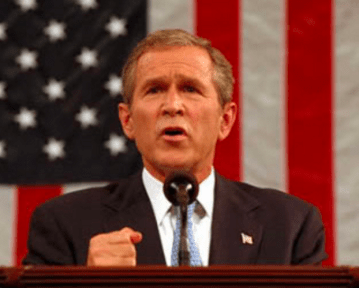
In his September 20, 2001 address to a joint session of Congress, President George W. Bush laid out a defining principle of his nascent war on terror: “We will pursue nations that provide aid or safe haven to terrorism. Every nation, in every region, now has a decision to make. Either you are with us, or you are with the terrorists.”
Even as he spoke those words, however, his administration had already embarked on a course that would mark them as a towering example of U.S. foreign policy hypocrisy. The Bush White House would soon present false claims linking 9/11 to Iraq, while simultaneously hiding credible evidence implicating Saudi Arabia—evidence summarized in the final, 28-page chapter of a 2002 joint congressional intelligence inquiry into 9/11.
Bush demanded the 28 pages be kept from the American public, and it’s increasingly clear why: As former State Department official Lawrence Wilkerson tells 28Pages.org, to a White House bent on selling an invasion of Iraq, compelling evidence of Saudi complicity in the attacks was an unwelcome distraction.
“You Talked About It At Your Peril”
Col. Lawrence Wilkerson
“They wanted to go to war with Iraq. Anything that supported al Qaeda connections with Baghdad, therefore, was good. Saudi Arabia just confused things so keep that out of it,” says Wilkerson, who served in the Bush administration as chief of staff to Secretary of State Colin Powell. “That wasn’t so much an effort to protect the Saudis, I don’t think, as it was an effort to justify the war with Iraq.”
The chilling effect on discussion of Saudi government links to 9/11 wasn’t confined to public statements—Wilkerson says the topic was taboo even within the Bush administration.
“It was verboten. It really was. You talked about it at your peril. You understood that the White House was going to close down anything associated with that sort of talk, so to what avail were you going to do it. I think one of the byproducts of (Vice President Dick) Cheney’s unprecedented eleven visits to CIA was to impress upon the most prominent of the intelligence agencies—and of course the Director of Central Intelligence himself—that you don’t want to go there,” says Wilkerson.
Cheney with King Abdullah in 2005
In other words, Saudi Arabia’s absence from the official 9/11 narrative was deliberate: “It wasn’t just passivity, it was action to prevent that from becoming a message,” he says.
To Wilkerson, the 28 pages—which detail direct and indirect links from the hijackers and other al Qaeda members to various Saudi government employees and even the Saudi ambassador to the United States—point to at least some degree of Saudi government attachment to the 9/11 attack.
“All of these people probably were agents of Saudi intelligence in addition to being the sort of suspicious characters, or more than just suspicious characters, associated with al Qaeda. If they were working for Saudi intelligence, don’t tell me the government or some institutional aspect of the government didn’t know about it,” says Wilkerson, who retired from the Army as a colonel before serving in the State Department.
Real Intelligence Suppressed, Phony Intelligence Elevated
Regardless of how strong the evidence pointing toward Saudi Arabia, Wilkerson says Cheney effectively dampened discussion of it—even within the intelligence community that was charged with rooting out those who enabled 9/11.
“My first meeting with (CIA director) George Tenet out at Langley when we were getting ready to get going on Powell’s presentation to the United Nations reinforced that in spades, by simply having John Hannah from the vice president’s office start everything off with his clipboard that was jam-packed with ‘Scooter Libby’s smorgasbord,’ as John called it, from which we could pick and choose as we wanted—except his saying there’s nothing in here about Saudi Arabia and Saudi Arabia will not be discussed,” says Wilkerson. (Libby was Cheney’s chief of staff.)
As they prepared that pivotal address, Wilkerson says he and Powell were under constant pressure to include claims that al Qaeda was linked to the Iraqi government.
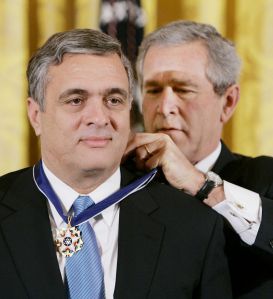
Tenet Receives Presidential Medal of Freedom
“You couldn’t kill it. We tried. We put a stake in that ten times, and it kept raising its head. The vice president would not turn it loose,” says Wilkerson. “That’s part of why they tortured people to try to and get more information on the connections between al Qaeda and Baghdad. It’s part of why they shifted their interrogation focus away from another attack on the United States to connections between al Qaeda and Baghdad—and anything that reinforced that, anything that made their case for war more ‘legitimate’ and more acceptable to the American people, they wanted.”
Days before the UN speech, Powell’s agitation over being pressured to include dubious information in the speech boiled over, said Wilkerson, and the two agreed to remove any content linking al Qaeda to Iraq.
The decision would be reversed in short order. As Wilkerson related to former CIA analyst Ray McGovern for a piece at Consortium News, “Within an hour, [CIA Director George] Tenet and [CIA Deputy Director John] McLaughlin dropped a bombshell on the table in the [CIA] director’s conference room: a high-level al Qaeda detainee had just revealed under interrogation substantive contacts between al Qaeda and Baghdad, including Iraqis training al Qaeda operatives in the use of chemical and biological weapons.”
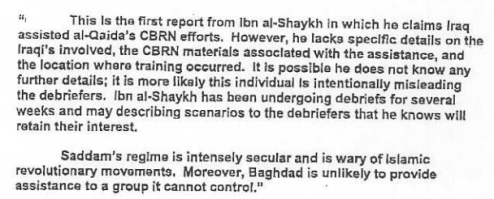
DIA Memo Disputes al-Libi Claim About Iraq—A Year Before Tenet Urged Its Inclusion in UN Brief
Powell ordered it to be added to the presentation. Later, well after Powell had presented it to the United Nations assembly and the world, the two would learn the claim was extracted a year earlier from detainee Ibn al-Sheikh al-Libi via torture at the hands of the Egyptians, and that the Defense Intelligence Agency gave it little credibility.
Al-Libi recanted the statement and died in a Libyan prison in 2009 of a reported suicide, but the tortured “evidence” had already served its terrible purpose: A September 2003 poll found that 69% of Americans felt it was likely Hussein was personally involved in the 9/11 attack.
Wilkerson has been an outspoken critic of U.S. torture of detainees; reflecting on the idea of torture to extract false intelligence, he described it as “even more heinous. It was not the lesser evil to prevent the greater evil, it was the lesser evil to enable the greater evil, because Iraq was the most catastrophic strategic decision in the post-World War II era, and that is a real powerful statement, because Vietnam was that before Iraq.”
“Vietnam in some sense is understandable as a theater in the Cold War that was badly misinterpreted,” he continues. “Iraq simply has no way of being understood. You have to lie, cheat and steal, as the neoconservatives are constantly doing, to explain Iraq. Iraq unleashed al Qaeda in Iraq. It unleashed ISIS. It unleashed everything that is happening that is destabilizing right now in western Asia.”
Hawijah, Iraq After U.S. Coalition Airstrike in 2015
Wilkerson relates a recent encounter that drives home the impact of the 2003 Iraq invasion: “A Jordanian prince said to me recently, ‘Go back to your country and tell your old boss—I know him well—that there is an Iraqi or Syrian family in every single Jordanian household, including the royal household. Go back and tell him that that is massively destabilizing and you are responsible.'”
Saudi Leads Never Pursued
There are, of course, two sides to the coin of post-9/11 Bush-Cheney duplicity: At the same time the administration falsely implied an Iraqi link to the attacks, it suppressed the broad evidence of Saudi connections detailed in the 28 pages.
Seeking to discredit those pages, the U.S. and Saudi governments and 9/11 Commission chairs Lee Hamilton and Tom Keane have claimed the commission thoroughly investigated the various circumstances in the 28 pages before concluding that—in the words of the its final report—it “found no evidence that the Saudi government as an institution or senior Saudi officials individually funded” al Qaeda.
Wilkerson isn’t buying it.
“It’s utter hogwash with regard to the entire set of circumstances surrounding 9/11 in my view,” says Wilkerson. “As far as I know, there never was an official investigation of so many of the things that are intimated in there, not least of which is a really hard look by the intelligence community at the ultimate question of (Saudi) government knowledge, government direction, even government strategy associated with the Salafist movement in general but, more specifically, organizations like al Qaeda.”
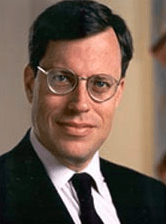
Philip Zelikow
Wilkerson says the 9/11 Commission’s avoidance of troubling conclusions about Saudi Arabia was pre-ordained with the selection of Philip Zelikow as its executive director. Zelikow had previously co-authored a book with Bush National Security Advisor Condoleezza Rice, served on the Bush transition team and had even written an articulation of Bush’s preemptive war doctrine that was issued in 2002 under the president’s signature.
“It was clear to me from the very beginning that he was there as a control agent. I didn’t know how definitively he would control the process until later,” says Wilkerson.
“He was tuned into the administration. He was tuned into what the administration wanted and he made sure that people who would pontificate later that they were totally independent, like Lee Hamilton and others, were in fact following the script. That’s understandable from a political point of view, but from an accountability point of view and even more so from a national security point of view, it’s damnable,” he says.
“You watch these things happen, and you understand why they’re happening from the perspective of the institutions with which you’re involved, the government with which you’re involved, but you never dream the extent to which these things will go in the long run and how much history, such as it is, depends upon their efforts and often times is distorted by their efforts.”
Brian McGlinchey is the founder and director of 28Pages.org.
Two weeks ago, after a declassification review led by the Office of the Director of National Intelligence (ODNI), the congressional intelligence committees finally released 28 pages from a joint congressional inquiry that outline a wide variety of connections between Saudi government officials, members of the Saudi royal family, suspected Saudi intelligence operatives and the 9/11 hijackers.
While the pages invite many questions about Saudi ties to the 9/11 attacks and just how thoroughly they were investigated by the 9/11 Commission, there are also many unanswered questions about the declassification itself.
Did President Obama ever read the 28 pages himself?
In 2009, Obama reportedly gave the first of two assurances to 9/11 family members that he would declassify the 28 pages. Seven years later—in April of this year—9/11 families were disappointed when he admitted he still hadn’t bothered to read the pages that were said to link a supposed ally to the worst terrorist attack in U.S. history.
“I have a sense of what’s in there. But this has been a process which we generally deal with through the intelligence community and Jim Clapper, our director of national intelligence, has been going through to make sure that whatever it is that is released is not gonna compromise some major national security interest of the United States,” the president told Charlie Rose.
The average adult can read 28 pages in about a half hour. One would hope Obama ultimately insisted on reading the pages for himself and didn’t rely on an ODNI recommendation that may have hidden important information not only from the American people but from Obama himself. The importance of his personally reading the pages is underscored by the possibility that, as discussed below, some of the still-redacted information may shed unflattering light on the very intelligence community that was performing the declassification review.
What’s still hidden from view?
Rep. Justin Amash
In the last hours before the release, Rep. Walter Jones—Capitol Hill’s foremost advocate for the release of the pages—was assured by an ODNI representative that the remaining redactions would be minimal. However, the public version of the 28 pages has 97 separate redactions, some of a single word or name and many representing multiple paragraphs in sequence.
In a Wednesday Q&A session following remarks at a convention of Young Americans for Liberty, Rep. Justin Amash—who had co-sponsored the House resolution that called for the release of the 28 pages—said he and fellow co-sponsor Thomas Massie intend to read both the public and the unredacted 28 pages side-by-side to see what’s still being kept under wraps.
What are the specific rationales for each redaction?
When declassifications occur under the Freedom of Information Act or the Mandatory Declassification Review process, each redaction is labelled to give the reader an understanding of the reason the information must remain secret. These labels usually don’t offer a lot of specificity, but instead simply refer to a provision of Executive Order 13526, which governs the classification system. For example, a label that says “E.O. 13526, section 1.4(c)” tells us the redaction is related to “intelligence activities (including covert action), intelligence sources or methods, or cryptology.”
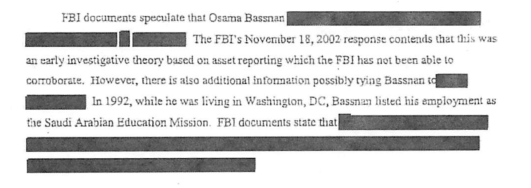
In the declassified 28 pages, however, there are no such labels, leaving us to question if there’s truly a bona fide national security reason behind every redaction. We confess that even a label wouldn’t necessarily remove that doubt, but it would at least represent an attempt by the government to justify each individual decision.
It’s important to note that E.O. 13526 explicitly prohibits classification meant to “conceal violations of law, inefficiency or administrative error,” “prevent embarrassment to a person, organization or agency” or “prevent or delay the release of information that does not require protection in the interest of the national security.” Looking at what we can read in the 28 pages, it’s hard not to conclude that President George W. Bush’s original classification of essentially every word of the 28-page chapter from the congressional inquiry was a violation of these rules.
Do some redactions provide lingering cover for Saudi Arabia?
On the day before the 28 pages were released, White House press secretary Josh Earnest seemed to indicate that the U.S.-Saudi relationship would be factored into just how much of the 28 pages the American people would finally be granted permission to read.
“We want to make sure that we factor in the diplomatic equities into a decision like that. So when that process is completed, we will obviously coordinate not just with the (Director of National Intelligence) but also with the Congress to make sure those diplomatic equities are properly factored in,” said Earnest.
Did the intelligence committees make adjustments to the redactions recommended by ODNI?
The release of the 28 pages was preceded by a intelligence community declassification review that President Obama requested in the summer of 2014. The White House portrayed the conclusion of that review as a recommendation from the intelligence community, with the ultimate decision on the release of the 28 pages left in the hands of Congress.
Considering the intelligence committees reportedly released the 28 pages on the same day they received the ODNI recommendation, it seems likely they chose to give full deference to the executive branch and made no adjustments. We’ll have to rely on the judgments of declassification advocates like Jones, Amash and Massie to see if that deference was actually warranted.
Were some of ODNI’s recommendations self-serving?
At a June press conference calling for the release of the 28 pages, Rep. Stephen Lynch seemed to imply that information in the 28 pages would be embarrassing to the intelligence community.
“There may be some very embarrassing facts, some very embarrassing moments, and some criticisms on our own intelligence service because of what happened, if all the facts come out,” said Lynch. “I think that those individuals (in the intelligence community) don’t want this to come out. They don’t want the facts to come out because it may reveal terrible, terrible errors on their part and they may bear part of the blame” for failing to prevent the 9/11 attacks.
The released 28 pages do contain some passages that don’t reflect well on the intelligence community, including an admission that, before 9/11, the FBI didn’t focus resources on Saudis in the United States “due to Saudi Arabia’s status as an American ‘ally.'” However, given nearly 100 redactions, we’re left to wonder if some of them are intended to safeguard individual and departmental reputations rather than national security.
What will become of the still-pending Mandatory Declassification Review of the 28 pages?
Separate from the intelligence community’s declassification review, the 28 pages were in a queue for a similar but not identical assessment by the Interagency Security Classification Appeals Panel, or ISCAP. That assessment—called a Mandatory Declassification Review (MDR)—was requested by attorney Tom Julin on behalf of investigative reporters Dan Christensen, Anthony Summers and Robbyn Swan.
ISCAP is dominated by representatives of the intelligence community, so it’s safe to assume it wouldn’t deviate much if at all from the recommendation produced by the ODNI review, and, in any event, the ultimate outcome of a Mandatory Declassification Review is a non-binding recommendation to the president.
While that could be a different president by the time the process is complete, we may find that the MDR, if seen through, would only give us the benefit of some token rationales for each of the remaining redactions.
In his first live U.S. interview since the declassification of 28 pages on Saudi government links to the 9/11 hijackers, 28Pages.org founder Brian McGlinchey today appeared on the Ron Paul Liberty Report, a daily opinion and analysis program hosted by former Congressman Ron Paul and Daniel McAdams, executive director of the Ron Paul Institute for Peace and Prosperity.
McGlinchey, Paul and McAdams discussed the inception of 28Pages.org, the recent declassification of the 28 pages and what their contents and the decision to hide them tell us about American foreign policy.
Paul and McAdams also announced that McGlinchey has been selected to speak at the Ron Paul Institute’s Peace and Prosperity 2016 Conference in Dulles, Virginia on Saturday, September 10.
After a 13-year battle that 28Pages.orgjoined two years ago, 28 pages on Saudi government links to the 9/11 hijackers were finally declassified on Friday. While there are frustratingly many redactions amounting to about three pages of content, the declassified pages contain many new details that should prompt demands for the release of additional documents that would shed further light on those details.
Continuing a pattern that began well before the pages were released, both the Saudi and U.S. governments assert that the 28 pages do not implicate senior Saudi government officials or members of the royal family in facilitating the attacks, and that Saudi Arabia is an important partner in the war on terror. A handful of revelations in the 28 pages undermine both claims.
Direct Payments from Prince Bandar to Hijackers’ Helper
Osama Bassnan was a Saudi citizen who lived in San Diego and boasted to an FBI asset about the assistance he provided to 9/11 hijackers Nawaf al-Hazmi and Khalid al-Midhar. The 28 pages describe Bassnan as an extremist and supporter of Osama Bin Laden who hosted a party for Omar Abdel-Rahman. Also known as “the Blind Sheikh,” Abdel-Rahman is now in prison for his role in the 1993 bombing of the World Trade Center.
It had previously been established that Bassnan’s wife had received a series of cashier’s checks from Princess Haifa, the wife of the Saudi ambassador to the United States and close confidant of President George W. Bush Prince Bandar. Those checks—which the 28 pages say totaled $74,000—were claimed to have been charitable in nature, meant to aid Bassnan’s wife in paying for medical treatments.
Newly revealed in the 28 pages is a direct payment of $15,000 from Bandar to Bassnan in May 1998. The pages also cite a CIA report that indicates Bassnan received a “significant amount of cash” from an unidentified member of the Saudi royal family in a 2002 Houston meeting—seven months after the attacks that killed nearly 3,000 people.
Bandar, Embassy Links to al Qaeda Associate Abu Zubaydah
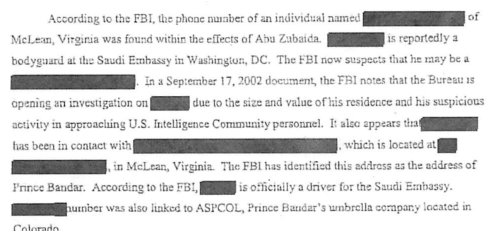
In March 2002, U.S. and coalition forces in Pakistan captured Abu Zubaydah, an apparent al Qaeda associate who was originally identified as a senior member of the terror organization but whose actual status is now in doubt. The 28 pages reveal that Zubaydah’s phone book contained an unlisted phone number linked to a small Colorado corporation was formed to facilitate the management of Prince Bandar’s spectacular Aspen home.
It also held a phone number of an individual whose name is redacted but who is identified as a bodyguard at the Saudi embassy in Washington. The 28 pages say “The FBI suspects that he may be a [ redacted ]” and that he was being investigated due to “the size and value of this residence and his suspicious activity in approaching U.S. Intelligence Community personnel.”
Suspicions of Saudi Government Money-Laundering
The 28 pages describe FBI suspicions that Saudi money was being laundered through businesses associated with Osama bin Laden, as well as through mosques and charities. Describing one such conduit, the 28 pages read, “According to the former FBI agent in San Diego who was involved in this investigation, this scheme may allow the Saudi government to provide al-Qa’ida with funding through covert or indirect means.”
The 28 pages also say “there are also indication of Saudi government support for terrorist activity through charitable organizations,” including the Saudi-based Umm al-Qura Islamic Charitable Foundation (UQ), which is described as being involved in “suspicious money transfers, document forgery, providing jobs to wanted terrorist suspects, and funding travel for youths to attend jihad training.” According to reports cited in the 28 pages, UQ couriers had transported more than $330,000 in cash, “most of which they received from Saudi embassies in the Far East.”
The American and Saudi governments would have us believe the 9/11 Commission thoroughly investigated these and many other leads before concluding it found no evidence of Saudi government support of al Qaeda. As we’ve explained before, an overwhelming amount of evidence—including statements from 9/11 Commission member John Lehman—undermines the idea that links to Saudi Arabia were thoroughly investigated.
Lack of Saudi Cooperation in Countering Terrorism
The 28 pages undermine the idea that Saudi Arabia’s is a reliable partner for the United States in countering terrorism. A veteran New York FBI agent described the Saudis as having been “useless and obstructionist for years.”
The pages also reveal that, in May 2001, the U.S. intelligence community sought Saudi assistance in finding an individual in Saudi Arabia who was in contact with Zubaydah and who was “most likely aware of an upcoming al-Qa’ida operation.” The Saudi government put conditions on assisting U.S. authorities with the matter and ultimately did not cooperate.
According to the 28 pages, the former chief of the CIA’s bin Laden unit said it was clear to him that, after 1996, the Saudi government would render no aid to the United States in its tracking of the al Qaeda leader. They also refer to a CIA memo that says the Saudis stopped providing information on bin Laden because he had “too much information about official Saudi dealings with Islamic extremists in the 1980s for Riyadh to deliver him into U.S. hands.”
Recommended Additional Reading
Much has been written about the 28 pages since their release; here are a few of the more noteworthy pieces so far.


 In his September 20, 2001


 “I have a sense of what’s in there. But this has been a process which we generally deal with through the intelligence community and Jim Clapper, our director of national intelligence, has been going through to make sure that whatever it is that is released is not gonna compromise some major national security interest of the United States,” the president
 In the declassified 28 pages, however, there are no such labels, leaving us to question if there’s truly a bona fide national security reason behind every redaction. We confess that even a label wouldn’t necessarily remove that doubt, but it would at least represent an attempt by the government to justify each individual decision.
 On the day before the 28 pages were released, White House press secretary Josh Earnest seemed to indicate that the U.S.-Saudi relationship would be factored into just how much of the 28 pages the American people would finally be granted permission to read.
 “There may be some very embarrassing facts, some very embarrassing moments, and some criticisms on our own intelligence service because of what happened, if all the facts come out,” said Lynch. “I think that those individuals (in the intelligence community) don’t want this to come out. They

 28Pages.org