As 28Pages.orgwas first to report last week, Kentucky Senator Rand Paul has introduced a Senate bill urging the president to declassify 28 pages on foreign government ties to the 9/11 hijackers. He will be joined in leading this effort by Oregon Senator Ron Wyden.
Senate Bill 1471 was introduced at a Capitol Hill press conference where Senator Paul was joined by Congressmen Walter Jones, Stephen Lynch and Thomas Massie as well as former Senator Bob Graham and several 9/11 family members, including Terry Strada, national chair of 9/11 Families and Survivors United for Justice Against Terrorism.
Press conference video courtesy of LaRouchePAC. 28Pages.org is not affiliated with LaRouchePAC but is grateful to that organization for its ongoing, professional video coverage of many events relating to this issue.
The growing, nonpartisan drive to declassify a 28-page finding on foreign government support of the 9/11 hijackers is about to take an enormous step forward with the introduction of a Senate bill urging the president to release the material to the public.
Dramatically compounding the issue’s visibility, the bill is being introduced by high-profile Republican presidential hopeful Rand Paul of Kentucky.
A spokesperson for Senator Paul told 28Pages.org that Oregon Democrat Ron Wyden will cosponsor the bill, which will serve as the upper chamber’s counterpart to House Resolution 14. Wyden is a member of the Senate intelligence committee.
Paul will unveil the Transparency for the Families of 9/11 Victims Act at a Capitol Hill press conference on Tuesday, June 2 at 10:00 am, joined by Representatives Walter Jones (R, NC), Stephen Lynch (D, MA), Thomas Massie (R, KY) and former Democratic Senator Bob Graham.
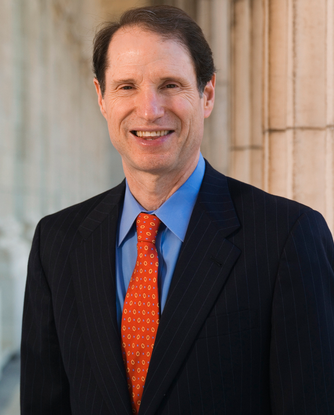
Senator Ron Wyden
Jones, Lynch and Massie introduced H.Res.14 and have been championing the issue—and seeking like-minded senators to lead the cause in the upper chamber—since December 2013.
Aided by Graham, who co-chaired the joint congressional 9/11 inquiry that wrote the 28 pages as one chapter in a far larger report, their success in securing the leadership of Paul and Wyden represents a critical milestone for the 28 pages movement.
As Paul and Wyden seek cosponsors for the bill, there are 11 senators whose support should—on principle, if not politics—be automatic: Patrick Leahy (VT), Barbara Mikulski (MD), Harry Reid (NV), Barbara Boxer (CA), Patty Murray (WA), Dick Durbin (IL), Jack Reed (RI), Chuck Schumer (NY), Bill Nelson (FL), Tom Carper (DE) and Maria Cantwell (WA). What do these 11 Democrats have in common? Months after the December 2002 release of the congressional intelligence report that holds the 28 pages, each of them signed a 2003 letter to President George W. Bush protesting his decision to redact the 28 pages and urging him to release them. In part, that letter read:
Unfortunately, because all but two pages of the entire section have been deemed too secret for public disclosure, the American people remain in the dark about other countries that may have facilitated the terrorist attacks. It has been widely reported in the press that the foreign sources referred to in this portion of the Joint Inquiry analysis reside primarily in Saudi Arabia. The decision to classify this information sends the wrong message to the American people about our nation’s anti-terror effort and makes it seem as if there will be no penalty for foreign abettors of the hijackers…Protecting the Saudi regime by eliminating any public penalty for the support given to terrorists from within its borders would be a mistake.
Among those 11 natural candidates to join the Paul-Wyden bill, one stands out: Schumer led the 2003 letter-writing effort. At the time, he said, “The bottom line is that keeping this material classified only strengthens the theory that some in the U.S. government are hellbent on covering up for the Saudis. If we’re going to take terrorism down, that kind of behavior has got to be nipped in the bud and shedding some light on these 28 pages would start that process.”
The 28 Pages and the Ongoing Scourge of Terrorism
Calling the bill the “Transparency for the Families of 9/11 Victims Act” is an important acknowledgement that 9/11 family members deserve to know the full circumstances of their loved ones’ murders—and to access information that could be useful in lawsuits they’ve filed against the Kingdom of Saudi Arabia.
Then again—given the broad impact of 9/11 and the ensuing “War on Terror,” 9/11 transparency is truly owed to every American citizen and to people all around the world. Former Senator Graham and House leaders of the 28 pages movement who’ve read the 28 pages argue that their release is vital to the ongoing struggle with terrorism.
According to Graham, “the 28 pages primarily relate to who financed 9/11 and they point a very strong finger at Saudi Arabia as being the principal financier.” He has also said the U.S. government’s shielding of Saudi Arabia’s role in funding extremism helped pave the way for the rise of ISIS. The House’s Lynch made a similar point in a 2014 story written by the Boston Globe’s Bryan Bender:
(Lynch) believes the information has direct bearing on the new war against the Islamic State in Iraq and Syria and other militant Sunni Muslim groups that are believed to be drawing some of their funding from the same Arab states that America considers key allies. The revelations are central to understanding “the web of intrigue here and the treacherous nature of the parties we are dealing with — the terrorists and their supporters,” Lynch said in an interview.
Kentucky Republican congressman Thomas Massie, in a memorable 2014 press conference, described the experience of reading the 28 pages as “shocking” and said “I had to stop every couple of pages and…try to rearrange my understanding of history…It challenges you to rethink everything.” (Watch it here.)
9/11 family members say President Obama, on two different occasions, gave assurances that he would release the 28 pages. Last September, responding to a report on the 28 pages by CNN’s Jake Tapper, the White House’s National Security spokesperson said, “Earlier this summer the White House requested that (the Office of the Director of National Intelligence) review the 28 pages from the joint inquiry for declassification. ODNI is currently coordinating the required interagency review and it is ongoing.”
It takes the average adult about 28 minutes to read 28 pages, but more than 8 months after the White House statement—and almost 14 years since the September 11 attacks—the pages remain under close guard in the basement of the United States Capitol. Brian McGlinchey is the founder and director of 28Pages.org
Follow us on Facebook and Twitter and build the 28 pages movement.
Earlier this month, investigative journalist Seymour Hersh challenged nearly every essential aspect of the United States government’s account of how it tracked, killed and disposed of Osama bin Laden.
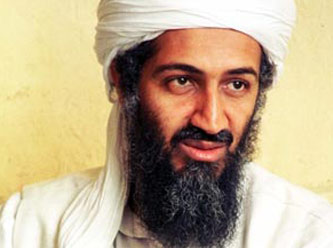
Osama bin Laden
Key threads in Hersh’s account, if true, suggest enduring ties between Saudi Arabia and al Qaeda, and paint alleged White House lies about bin Laden’s demise as yet another part of a multifaceted U.S. effort to keep Saudi Arabia’s terror ties under wraps—an effort that, according to former Senator Bob Graham, depends heavily on the continued classification of a 28-page finding on foreign government support of the 9/11 hijackers.
A Challenge to the White House Story
In case you blinked and missed the media’s fleeting examination of Hersh’s 10,000-word piece for the London Review of Books, here are some of the most noteworthy claims Hersh attributes to confidential sources:
Bin Laden wasn’t hiding from Pakistani authorities—he’d been captured by them and secured at the Abbottabad compound under house arrest.
Bin Laden’s location in Abbottabad wasn’t uncovered by the CIA’s savvy tracking of an al Qaeda courier or aided by the torture of captives—it was handed to the CIA by a Pakistani informer keen on securing a $25 million reward.
The Kingdom of Saudi Arabia financed bin Laden’s Abbottabad accommodations.
The raid to kill bin Laden was conducted with the acquiescence of the Pakistani army and intelligence service.
Pakistani guards had been instructed to flee the compound upon hearing the sound of approaching helicopters—and an unarmed bin Laden was simply exterminated by Navy SEALs who entered the structure unopposed.
Bin Laden wasn’t buried at sea; his body was thrown from a helicopter flying over the Hindu Kush mountains.
To hide Pakistan’s role, the original arrangement called for the U.S. government to wait about a week after bin Laden’s murder and then announce he’d been killed in a drone strike. The crash of a helicopter used in the raid prompted the Obama administration to hastily craft a different set of lies for public digestion.
Delving Deeper into the Alleged Saudi Connection
For those seeking the declassification of a 28-page passage on foreign government ties to the 9/11 hijackers, the claim that Saudi support of bin Laden lasted years after 9/11 is of particular interest, as it complements an assertion by Senator Graham that the 28 pages “point a very strong finger at Saudi Arabia as being the principal financier” of the September 11 attacks.
Consider this passage from Hersh’s piece:
A worrying factor at this early point, according to the retired (senior U.S. intelligence) official, was Saudi Arabia, which had been financing bin Laden’s upkeep since his seizure by the Pakistanis. ‘The Saudis didn’t want bin Laden’s presence revealed to us because he was a Saudi, and so they told the Pakistanis to keep him out of the picture. The Saudis feared if we knew we would pressure the Pakistanis to let bin Laden start talking to us about what the Saudis had been doing with al-Qaida. And they were dropping money – lots of it.
Seymour Hersh (Photo: Institute for Policy Studies)
Hersh’s intelligence source also pointedly counters the White House’s assertion that Seal Team Six aimed to take bin Laden alive: “It was clearly and absolutely a premeditated murder.” According to Hersh, Pakistan had made bin Laden’s death a condition for its easing the path for the Seal team’s assault.
However, given the U.S. intelligence community’s claims about its prowess in extracting valuable intelligence from captives—and the government’s portrayal of bin Laden as having continued to play a vital role in al Qaeda well after 9/11—one would expect the White House to place an extraordinarily high priority on capturing him alive. Holding extraordinary leverage over the Pakistanis, such a demand should have been dismissed out of hand.
It’s speculative, but did the U.S. government have its own reasons for silencing bin Laden—perhaps to shield Saudi Arabia’s ties to the al Qaeda leader? Earlier this year, it was revealed that “20th hijacker” Zacarias Moussaoui testified—in lawsuits filed against Saudi Arabia by 9/11 family members, victims and insurers—that the Saudi royal family had financed al Qaeda. Did the American government want to prevent bin Laden from emerging as a far more credible star witness against the Saudis?
If so, such a “dead men tell no tales” rationale for bin Laden’s execution would be consistent with a striking statement Senator Graham made earlier this year:
“While the 28 pages are maybe the most important and the most prominent, they are by no means the only example of where information that is important to understanding the full extent of 9/11 havealso been withheld from the American people.
This is not a narrow issue of withholding information at one place, in one time. This is a pervasive pattern of covering up the role of Saudi Arabia in 9/11, by all of the agencies of the federal government which have access to information that might illuminate Saudi Arabia’s role in 9/11.”
Controversy Over the Hersh Story
Hersh’s story immediately came under fire from the White House and others inside and outside of government. Some of the criticism focused on the fact that Hersh’s sources are confidential—an avenue of attack that seems rather blunt given the widespread use of confidential sources in national security reporting and the Obama administration’s record-breaking prosecutions of whistleblowers.
On the other hand, other writers support many of the most important claims in the Hersh piece. For example, just days after the 2011 raid, Larry Johnson, a former CIA officer, wrote about the Pakistani informer, Pakistan’s house arrest of Bin Laden and the Saudi maintenance payments.
Responding to Hersh’s work, veteran Pakistan and Afghanistan reporter Carlotta Gall wrote a piece in The New York Times in which she said “the story of the Pakistani informer was circulating in the rumor mill within days of the Abbottabad raid,” and added, “two years later…I learned from a high-level member of the Pakistani intelligence service that the ISI had been hiding Bin Laden and ran a desk specifically to handle him as an intelligence asset.”
28Pages.org cannot validate Hersh’s reporting. However, given his credentials and other outlets reinforcing key parts of his story, we think his account at least merits consideration by the public and further investigation by other journalists.
Of course, there’s one aspect of 9/11 that’s incontrovertible: There exists a 28-page finding on foreign government links to the 9/11 hijackers that’s being hidden from the American people—28 pages that have been called “shocking” by legislators who’ve read them. And it’s time for those pages to be published for all the world to see.
The latest edition of Jon Gold’s “We Were Lied to About 9/11” podcast (embedded below) is an in-depth interview with former Senator Bob Graham, who co-chaired the joint congressional inquiry into intelligence community activities before and after 9/11. The 28-page finding on foreign government support of the 9/11 hijackers is found in report of that inquiry.
If you’re generally frustrated by interviewers who know little about the dense web of foreign and domestic intrigue that is 9/11, you’ll find Gold a welcome departure from the norm.
Among many other things, Gold and Graham discussed the 28 pages, allegations that the Pakistani intelligence agency transferred money to lead 9/11 hijacker Mohammed Atta, the FBI’s concealment of what it knows about the Sarasota terror cell and Vice President Dick Cheney’s adversarial approach to the 9/11 investigations.
Regarding the 28 pages, Graham said “That chapter refers primarily to the issue of who financed 9/11 and it points a very strong finger of suspicion at Saudi Arabia.” He also noted that the classified chapter “goes to one of the remaining areas of lack of consensus and that is, did the 19 hijackers operate alone or did they have support from some external source? The official position of the United States executive—including the intelligence community, the FBI , the White House—is that they acted alone. It is the position of the leadership of both the congressional inquiry and the 9/11 citizens commission that it was highly implausible that the 19 hijackers, given their lack of linguistic familiarity and the the fact that most of them had never been to the United States before they came for the purpose of 9/11, that they could have carried out such a complex plot over a long period of time, maintaining their anonymity, being able to practice to the point that they carried out the plot with such devastating effect.”
Graham also said that Bush and Obama administrations’ concealment of Saudi ties to the 9/11 hijackers has “adversely affected our national security by giving Saudi Arabia the not unreasonable conclusion that Saudi Arabia is immune to any sanction for its actions and can…continue to support al Qaeda” and provide resources to ISIS, whose formation it helped facilitate. “American national security has been weakened by the failure to let the American people and the world know what Saudi Arabia did around 9/11 and subsequent to 9/11,” Graham added.
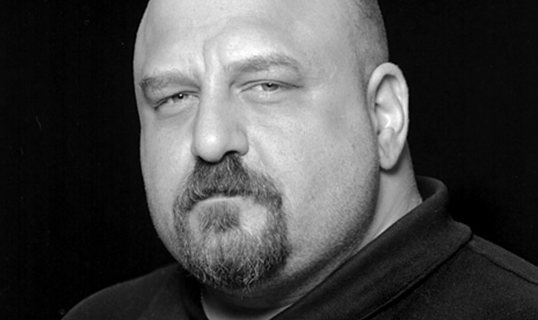
Jon Gold
Gold asked Graham a question of particularly high interest to us at 28Pages.org: Could he confirm the 28 pages document support of the 9/11 hijackers from more than one country? Unfortunately, Graham replied with a flat “no,” which we interpreted—without complete confidence—as a refusal to comment rather than a dismissal of the notion that Saudi Arabia isn’t the only foreign country implicated in the 28 pages.
Though the 28 pages have received significant publicity, Graham said “the 28 pages are by no means the totality of instances in which Saudi Arabia’s actions have been covered up by U.S. officials.” In addition to the FBI’s remarkable lack of transparency regarding its investigation of the Sarasota cell, Graham also highlighted the FBI’s blocking of the congressional inquiry’s request to interview an FBI informant who actually housed two of the hijackers.
“You had the anomalous situation of a paid FBI agent being the landlord of two of the future hijackers. We very much wanted to talk to that man,” said Graham. “We thought he had a peculiar access to the hijackers and to information about the actions of the FBI, but the FBI went to great lengths, including refusing to serve a subpoena, which it alone could serve because at that point the man was in protective custody and they were the only entity who knew of where he was and could provide access to him.”
Appealing directly to Gold’s audience for support for the declassification effort, Graham suggested they participate by writing a letter, sending an email or placing a call to their representatives and senators.
Those are just some highlights—we recommend listening to all of it, and exploring the many other interesting discussions Gold has hosted. “We Were Lied to About 9/11” is accessible via iTunes and YouTube.
Do your representatives and senators support the release of the 28 pages? Contact them today.
In a story published Monday, The Hill’s Martin Matishak and Julian Hattem made a very important contribution to the growing movement to declassify 28 pages on foreign government support of the 9/11 hijackers—by providing the best indication yet of the just how few members of the House have read the censored material.
According to Matishak and Hattem:
A spokesman for Rep. Devin Nunes (R-Calif.), the Intelligence panel’s chairman, said the committee granted more than 30 requests from lawmakers to view the pages in the 113th Congress.
That tally is disappointing but not surprising, confirming suspicions of extremely low readership voiced by 28Pages.org in September.
Professional Curiosity in Short Supply
The 113th Congress ended its two-year run in December 2014, a full year after Congressmen Walter Jones and Stephen Lynch began urging peers to read the 28-page chapter of a joint Congressional intelligence report on 9/11.
Knowing Jones, Lynch and Massie account for three of the “more than 30” requests granted by the intelligence committee during the last congress, The Hill’s report suggests that fewer than one in ten of the trio’s peers were moved to action by these attention-grabbing descriptions of the 28 pages:
Jones: “I was absolutely shocked by what I read. What was so surprising was that those whom we thought we could trust really disappointed me.”
Lynch: “These pages contain information that is vital to a full understanding of the events and circumstances surrounding this tragedy.”
Massie: “I had to stop every two or three pages and rearrange my perception of history….it’s that fundamental.”
These statements were sufficient to spark the creation of a grassroots movement—and the launch of 28Pages.org—yet they weren’t enough to prompt the typical member of Congress to make the short trip to the Capitol basement to read the 28 pages themselves.
Congressman Stephen Lynch
These 28 pages aren’t just about history. Lynch told The Boston Globe that, in the context of the war on terror, the 28 pages illuminate “the web of intrigue here and the treacherous nature of the parties we are dealing with — the terrorists and their supporters.”
At a time when Congress is contemplating a new authorization of military force in the Middle East, it’s no exaggeration to say that casting a life-and-death vote on counter-terror strategy without having read the 28 pages is tantamount to legislative malpractice.
Matishak and Hattem deserve credit for providing this critical information, and intelligence committee chairman Nunes should be applauded for enabling this initial level of transparency. That said, more transparency is needed—specifically, the names of those in both houses of Congress who have read the 28 pages.
The Bright Side
While confirming our worst suspicions about 28-pages readership on the Hill, Matishak and Hattem’s report offered a measure of encouragement, too: Eight more requests to read the censored passage were approved by the House intelligence committee on Thursday.
In that same week, seven new cosponsors joined House Resolution 14, which urges the president to declassify the 28 pages. With heightened media attention and increased involvement by citizens in the form of calls and letters to Congress and letters to newspaper editors, we’re confident that number will continue to grow.
Has your representative read the 28 pages? Ask today.






 28Pages.org