In an important development in the drive for greater 9/11 transparency, John Lehman, the former U.S. Navy secretary who served on the 9/11 Commission, has criticized recent statements by commission co-chairs Tom Kean and Lee Hamilton. The two had cast doubt on the reliability of 28 classified pages from a congressional intelligence inquiry and also said their commission had only identified one Saudi official as being implicated in aiding the hijackers.
Lehman’s statements appeared in a piece for The Guardian written by Philip Shenon, author of The Commission—the most exhaustive and revealing account of the 9/11 Commission’s work. Shenon wrote:
In the interview Wednesday, Lehman said Kean and Hamilton’s statement that only one Saudi goverment employee was “implicated” in supporting the hijackers in California and elsewhere was “a game of semantics” and that the commission had been aware of at least five Saudi government officials who were strongly suspected of involvement in the terrorists’ support network.
“They may not have been indicted, but they were certainly implicated,” he said. “There was an awful lot of circumstantial evidence.”
Lehman wasn’t the only commission member who spoke out via Shenon:
Another panel member, speaking of condition of anonymity for fear of offending the other nine, said the 28 pages should be released even though they could damage the commission’s legacy—“fairly or unfairly”—by suggesting lines of investigation involving the Saudi government that were pursued by Congress but never adequately explored by the commission.
“I think we were tough on the Saudis, but obviously not tough enough,” the commissioner said.
Shenon also reviews several indications that the commission’s pursuit of Saudi leads may have been thwarted—with specific references to the actions of commission executive director Philip Zelikow.
It’s a must-read; rather than fully summarizing it, we’ll instead urge you to read it all, and to also read our recent piece that makes the case that recent statements by Kean, Hamilton and Zelikow about the 28 pages are likely intended to guard their reputations against a truth that’s becoming more evident each day: The 9/11 Commission failed to vigorously examine potential Saudi ties to 9/11.
In other news today:
Three more members of Congress have cosponsored House Resolution 14, which urges the president to declassify the 28 pages: Brad Sherman (D, CA-30), Barbara Lee (CA-13) and Jackie Speier (CA-14). This new trio from the president’s own party brings the total to 52.
A story by Shane Harris at The Daily Beast dives deep into the mystery of the wealthy Saudi family that abrubtly left their Sarasota home just two weeks before the 9/11 attacks—but, according to some, not before having contacts with hijackers, including Mohammed Atta.
At Salon, Marcy Wheeler offers a new perspective on the NSA’s failures in the weeks leading up to 9/11, and the positively disturbing extent to which relationships with large government contractors influenced decisions and the drive for accountability.
In recent weeks, the director of the CIA and the co-chairmen and executive director of the 9/11 Commission have claimed that 28 redacted pages from a congressional inquiry into 9/11 contain “unvetted,” “uncorroborated” and “inaccurate” information.
There’s ample reason to doubt those characterizations and to question the motives of the individuals making them. However, a leading classification expert told 28Pages.org that, even if assumed true, those claims cannot be used to justify the continued secrecy of the 28 pages, which are said to describe specific indications of Saudi government support of the 9/11 hijackers.
“The 28 pages could be entirely false, malicious and nonsensical. That is not a basis for classification and that should not be an impediment to their declassification,” said Steven Aftergood, who directs the Federation of American Scientists’ Project on Government Secrecy.
“The argument that it’s unvetted and inaccurate is obviously self-serving. It implies that other documents that are officially released are by definition accurate, which we know is not necessarily true, and in any case it’s not a basis for national security classification. If you examine the executive order governing the classification system, it does not say that information that is inaccurate or unvetted may be classified. Those words aren’t in there,” said Aftergood.
Release Could Be Accompanied by a Rebuttal
Whether claims about the reliability of the 28 pages are sound or not, Aftergood points to a simple way for such concerns to be addressed if and when the pages are published: “Whoever releases it could publish their own commentary or caveat or disavowal,” he says, and make the case as to why the information isn’t reliable.
Recent history offers an example of an intelligence community rebuttal to a controversial release of information: the CIA’s response to the Senate intelligence committee’s release of the executive summary of its investigation into the CIA’s torture and rendition program. “CIA issued its own dissenting remarks and they could do the same for the 28 pages if they were so inclined,” said Aftergood.
Meanwhile, former Senator Bob Graham, who co-chaired the inquiry that produced the 28 pages as part of a much larger report, has his own rebuttal to suggestions that they are a flimsy collection of unvetted, preliminary leads. “There’s been no questions raised about the professionalism and quality of the other 820 pages of that report and this chapter followed the same standards that they did,” said Graham.
Two Years of Declassification Review: “It Shouldn’t Take That Long”
President Obama tasked Director of National Intelligence James Clapper with reviewing the 28 pages for declassification in the summer of 2014; a spokesperson for the National Security Council declined a request from 28Pages.org to clarify on what day or even in which month that tasking took place.
The entire joint congressional intelligence inquiry that produced the 28 pages took a little over six months. That means the review of just 28 pages has now taken close to four times as long as an undertaking that entailed, among other things, reviewing nearly a half million pages of documents, conducting roughly 300 interviews, holding 13 closed-door sessions and nine public hearings and writing a report spanning more than 800 pages.
“It’s discouraging,” said Aftergood. “It shouldn’t take that long. It must have been on the back burner somewhere. It may be that the 60 Minutes story got it on the front burner again. Realistically, it could take months. It should not take years.”
Echoing recent statements by the co-chairmen and the executive director of the 9/11 Commission, CIA director John Brennan today used an appearance on Meet the Press to cast doubt on the contents of 28 classified pages from a joint congressional intelligence inquiry that are said to link Saudi Arabia to the attacks.
Claiming that he is “quite puzzled” by former Senator Bob Graham and others who have read the 28 pages and are campaigning for their declassification, Brennan described the final chapter of the 2002 inquiry’s report as containing “uncorroborated, unvetted information” and “basically just a collation of information that came out of FBI files.”
In his own Meet the Press appearance last week, Graham countered the notion that the 28 pages are a grab-bag of unsubstantiated leads, pointing to the fact that the 28 pages are just one part of a report spanning nearly 850 pages. “There’s been no questions raised about the professionalism and quality of the other 820 pages of that report and this chapter followed the same standards that they did,” said Graham.
Brennan’s Critical Yet Flawed Premise
Much as 9/11 co-chairs Tom Kean and Lee Hamilton and executive director Philip Zelikow have done in recent days, Brennan portrayed the 28 pages as obsolete: “The 9/11 Commission took that joint inquiry, and those 28 pages or so, and followed through on the investigation. And they came out with a very clear judgment that there was no evidence that indicated that the Saudi government as an institution, or Saudi officials individually, had provided financial support to Al Qaeda.”
Brennan’s discrediting of the 28 pages relies on a key underlying premise: that the 9/11 Commission thoroughly investigated the indications of Saudi support found in the 28 pages. However, as we described in detail on Thursday, there’s a compelling case that the commission failed to do so, thanks to obstructionism by the George W. Bush administration, the commission’s lackluster efforts to overcome it and the possibility that executive director Zelikow deliberately aided the White House in curtailing investigation of Saudi connections.
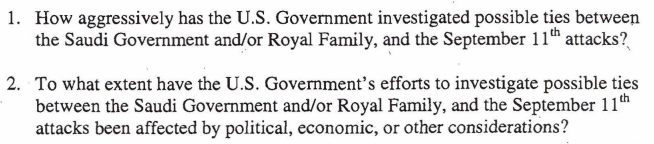
Meanwhile, a recently declassified document revealed that two 9/11 Commission investigators assigned to examine the kingdom’s links to the hijackers were so wary of political influence on their work that they actually recommended making a probe of that phenomenon a key facet of their investigation.
Excerpt from Declassified 9/11 Commission Document
Brennan also pointed to the separate 9/11 Review Commission as having reinforced the conclusions of the 9/11 Commission: Note that undertaking was managed by the FBI—which has its own demonstrated record of concealing information that might implicate Saudi Arabia.
Ulterior Motives
Efforts by Brennan, Kean, Hamilton and Zelikow to discredit the 28 pages should be viewed in light of their possible motives. For the 9/11 Commission leaders, those motives may be deeply personal: To the extent the 28 pages counter the commission’s verdict on Saudi links, they pose a very real threat to their professional reputations.
The CIA director’s potential motives are likely more far-reaching; we’ll examine three of them.
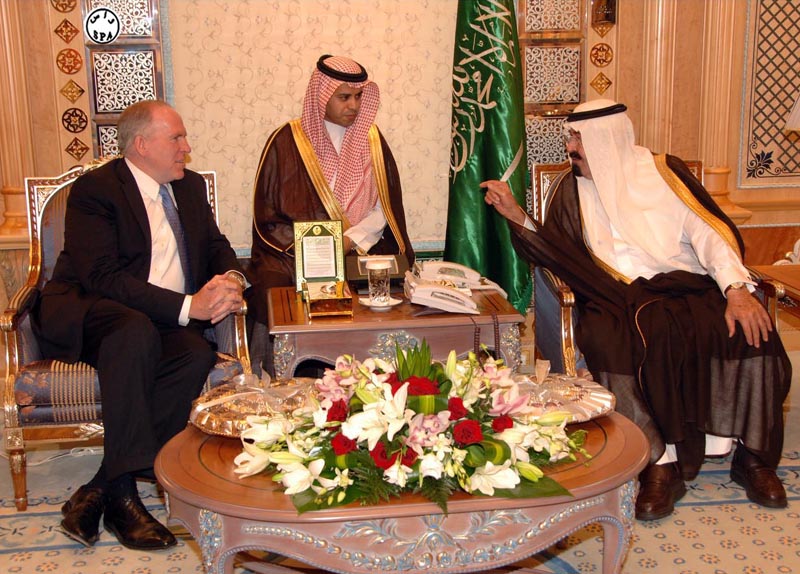
Brennan with Saudi King Abdullah in 2009
First, there’s the long and bipartisan tendency of the U.S. government to preserve U.S.-Saudi relations at all costs. That tendency is cultivated by Saudi Arabia’s enormous public relations and lobbying efforts in the United States, which includes financial ties to many of the think tanks that shape the opinions of government officials, journalists and the public. On Meet the Press, Brennan himself boasted, “I have very close relations with my Saudi counterparts.”
Second, there’s the possibility that the revelation of the 28 pages could strike an enormous blow against the entire narrative of the U.S.-led “war on terror,” in which Brennan’s bureaucracy plays a central role.
In the wake of 9/11, the United States and its partners have lashed out militarily in Iraq, Afghanistan, Pakistan, Somalia, Yemen, Libya and Syria. Graham, however, says the 28 pages “point a very strong finger at Saudi Arabia as the principal financier” of the attacks, and Minnesota Rep. Rick Nolan, who has read the 28 pages, recently said, “They confirm that much of the rhetoric preceding the U.S. attack on Iraq was terribly wrong.”
Finally, the 28 pages may reveal embarrassing details about the CIA’s conduct before the 9/11 attacks. Many of the Saudi-9/11 connections detailed elsewhere in the joint inquiry revolve around San Diego-based hijackers Khalid al-Midhar and Nawaf al-Hazmi, so it’s reasonable to think the chapter on financial support focuses on them as well.
In January 2000, the CIA learned that al-Midhar, who had already been linked to two 1998 U.S. embassy bombings in Africa, had obtained a multi-entry visa permitting him to freely travel to and from the United States. When two FBI agents assigned to the CIA’s al-Qaeda unit tried to alert their headquarters, the CIA stopped them.
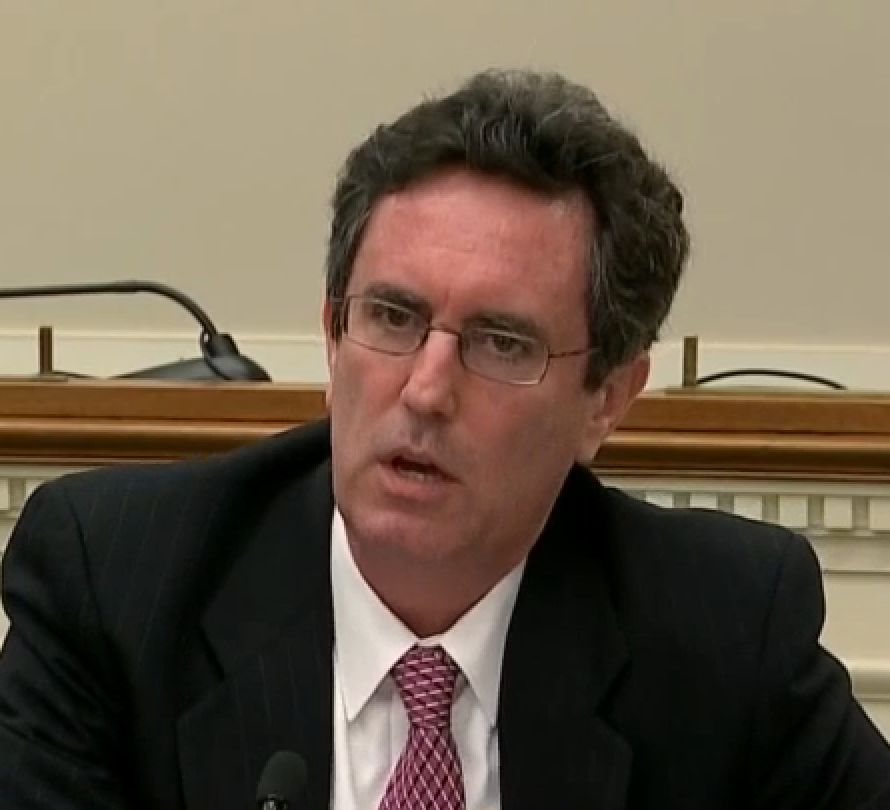
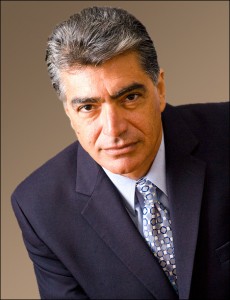
Mark Rossini
One of those agents, Mark Rossini has a theory for the CIA’s catastrophic silencing of himself and agent Doug Miller: He believes the CIA was attempting to turn al-Midhar into a CIA asset. If conducted on U.S. soil, that action would have been unlawful, Rossini says. Former White House counter-terrorism czar Richard Clarke shares Rossini’s theory.
Awaiting Media Scrutiny of Brennan’s Motives
Thus far, Kean, Hamilton and Zelikow’s assault on the credibility of the 28 pages has been reported by journalists and echoed in editorials without any scrutiny of their potential motives. Let’s hope that one-dimensional approach subsides in the wake of Brennan’s own salvo against the 28 pages, and that his remarks are weighed against those of many others who’ve read them.
Said one unnamed government official: “We’re not talking about rogue elements. We’re talking about a coordinated network that reaches right from the hijackers to multiple places in the Saudi government.”
With the campaign to declassify 28 pages from a congressional inquiry moving ever closer to its goal, the chairmen and executive director of the 9/11 Commission are doing their best to discount the significance of the pages, which are said to illustrate damning ties between Saudi Arabia and 9/11.
In interviews, a formal statement and an op-ed piece, the three have cast doubt on the contents of the final, 28-page chapter of a 2002 congressional report.
Their aspersions can be reduced to two propositions:
Comparable to “preliminary police notes,” the 28 pages are a collection of “raw, unvetted material,” and were rendered obsolete after the 9/11 Commission fully investigated those and other leads and issued its own final conclusions.
Releasing the 28 pages in full could cast a shadow of guilt on individuals who, via the 9/11 Commission’s investigation, were later deemed innocent.
As citizens and journalists weigh the commentary of commission chairmen Tom Kean and Lee Hamilton and executive director Philip Zelikow, they should consider the possibility that members of the Saudi royal family aren’t the only ones whose reputations may be harmed by the release of the pages: To the extent that the release of the 28 pages undermines the conclusions of the 9/11 Commission, Kean, Hamilton and Zelikow may have an interest in minimizing their significance.
Before we proceed, note the 28 pages are not in the 9/11 Commission Report—they’re in the report of a joint congressional intelligence inquiry that preceded the commission.
Conflicting Justifications for Secrecy
There’s a glaring disconnect between the rationale for the redaction of the 28 pages advanced by Zelikow, Kean and Hamilton and the one offered by President George W. Bush when he classified them. While the three commission leaders argue that secrecy was warranted because the material was unvetted and hence unreliable, Bush said classification was necessary to protect intelligence “sources and methods.”
Republican Porter Goss, who co-chaired the joint inquiry and supports the release of the pages, likewise struck national security chords in 2003 as he tried to put the best face on Bush’s decision, saying nothing to question the reliability of the information that was concealed.
Speaking broadly of the need to keep some information in the 838-page report secret, Goss said, “You have to remember we are at war and there are some actionable items still being pursued by the appropriate authorities.” Then, apparently referring to the 28 pages, he said, “You’ll find there’s a couple of blank pages…as soon as the actions that are necessary to deal with those issues are completed, those pages will be filled out.” Not revised, corrected or repudiated after vetting. “Filled out” after action is taken.
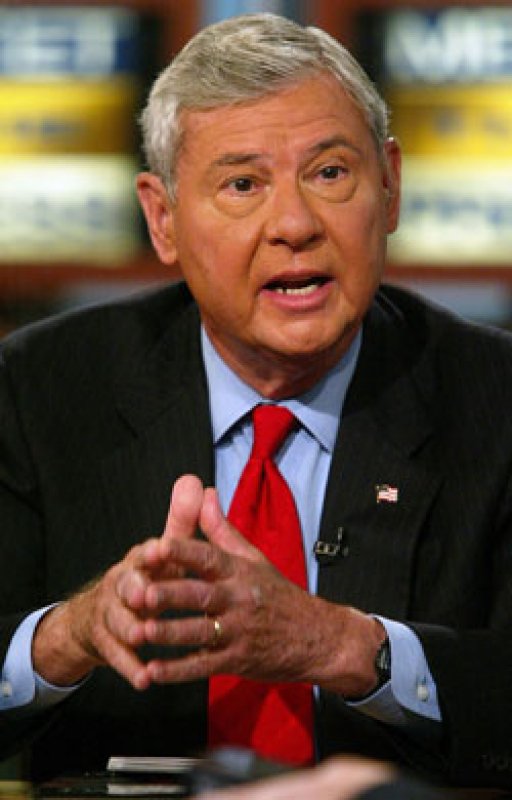
Bob Graham
On Sunday’s Meet the Press, former Senator Bob Graham, who co-chaired the joint inquiry, flatly refuted the idea that the 28 pages are raw, unvetted material.
Asked if it’s correct to compare the 28 pages to leads in an initial police report, Graham replied, “No. This report was 850 pages. This is 28 pages out of that. There’s been no questions raised about the professionalism and quality of the other 820 pages of that report and this chapter followed the same standards that they did.”
Serious Doubts About Thoroughness of Commission
In their Friday statement, Kean and Hamilton remind us that the commission—as controversially stated on page 171 of its report—“found no evidence that the Saudi government as an institution or senior Saudi officials individually funded” al Qaeda.
That assertion raises a question that goes to the heart of the 28 pages controversy, a question that could threaten the reputations of Kean, Hamilton and Zelikow: Just how thoroughly did the 9/11 Commission pursue leads both inside and outside the 28 pages that point toward Riyadh?
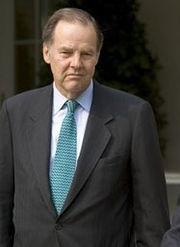
Philip Zelikow
Though it may come as a surprise to journalists who are reporting the trio’s criticism of the 28 pages without scrutinizing much less acknowledging their potential conflicts of interest, there are many reasons to doubt that the probe of Saudi links was pursued with the vigor that 9/11 victims and the American people deserved.
That doubt specifically springs from Hamilton and Kean’s lack of investigative assertiveness in the face of Bush administration obstructionism, and the manner in which executive director Zelikow ran the inquiry.
Commission member and former senator Bob Kerrey, in a statement submitted in the 9/11 victims’ suit against Saudi Arabia, said “evidence relating to the plausible involvement of possible Saudi government agents in the September 11th attacks has never been fully pursued.”
As Philip Shenon recounted in The Commission, 9/11 commission member and former Navy secretary John Lehman “was struck by the determination of the Bush White House to try to hide any evidence of the relationship between the Saudis and al-Qaeda. ‘They were refusing to declassify anything having to do with Saudi Arabia,’ Lehman said. ‘Anything having to do with the Saudis, for some reason, it had this very special sensitivity.'”
Kean and Hamilton, against advice from commission member and former deputy attorney general Jamie Gorelick, ruled out the routine use of subpoenas to compel full cooperation by various parts of the government, including the White House.
Bush had a close personal relationship with Prince Bandar bin Sultan, the Saudi ambassador to the United States. Investigators learned Bandar’s wife wrote checks worth tens of thousands of dollars that eventually found their way to the wife of Omar al-Bayoumi, who is widely suspected of being a Saudi government operative. Bayoumi helped two future 9/11 hijackers find lodging and provided ongoing assistance to them. (With an admitted air of speculation, note that Lehman told 60 Minutes the 28 pages not only named names, but that “the average intelligent viewer of 60 Minutes would recognize them instantly.”)
The commission bent to the White House’s controversial demands that Bush and Vice President Dick Cheney only be interviewed by a limited number of commission members, in private at the White House, with no recording or transcription of the conversation. Kean and Hamilton also conceded to the extraordinary White House stipulation that Bush and Cheney were to be interviewed simultaneously, as a team.
Commission member Slade Gorton said the questioners, apparently mesmerized by the Oval Office environment, went easy on Bush and Cheney: “Several of my colleagues were not nearly as tough in the White House as they were when they went in.” Lehman asked Bush about the money transfers from Bandar’s wife to the wife of the alleged hijacker-handler in San Diego. “He dodged the questions,” said Lehman.
Zelikow had close ties to the Bush administration: He co-authored a book with Condoleezza Rice, worked on the transition team and commission staffers were alarmed to learn, against policy, he had ongoing contacts with Bush political advisor Karl Rove during the investigation. The first public witness Zelikow called was an individual with no special expertise on 9/11 who used the opportunity to endorse the U.S. invasion of Iraq that had commenced the week before.
Mike Jacobson and Dana Lesemann wrote the 28 pages for the congressional inquiry and also worked for the commission. When they set out to further their investigation of Saudi links, they compiled a list of 20 individuals they wanted to interview. Zelikow declared 20 was too many, and directed them to pick just 10, going against basic investigative principles that suggest casting as wide an initial net as possible.
After repeatedly asking Zelikow for access to the 28 pages without effect, Lesemann, fed up, went around him to gain access on her own; when Zelikow found out, he fired her.
With the commission’s final report nearly complete, Jacobsen was alarmed by a midnight call tipping him off that Zelikow and commission investigator Dieter Snell were rewriting findings that dealt with Saudi Arabia. As Shenon wrote, they removed “virtually all of the most serious allegations against the Saudis” and shifted important information into the footnotes. Members of the investigative team felt the excessive standard of proof demanded by Snell would effectively exonerate the guilty.
Rep. Walter Jones read the 28 pages and is championing their release. Asked last week if the government derailed the investigation to protect Bandar and other VIPs, Jones said, “Things that should have been done at the time were not done. I’m trying to give you an answer without being too explicit.”
New Indications of Political Influence on Saudi Investigation
Last week, 28Pages.orgbroke news by drawing to public notice a recently declassified 9/11 Commission document. While its revelation of a mysterious Saudi embassy envelope made headlines around the world, another revelation has thus far flown largely under the media radar: Jacobson and Lesemann, at the outset of their commission work, questioned the aggressiveness of the investigation of links between the 9/11 attacks and the Saudi Arabia, and wanted to probe the extent to which “political, economic and other influences” had affected that line of inquiry.
Organizationally set apart from dozens of other questions as among the more important, overarching lines of inquiry for their particular avenue of the commission’s work, the significance of the questions’ presence in Document 17 is amplified by the absence of corresponding answers in the commission’s final report.
At some point—perhaps after Lesemann’s determined interest in Saudi links to 9/11 led to her dismissal—someone apparently determined a public study of those critical questions was beyond the scope of work.
Between facts old and new, there seems ample reason to place an asterisk after the 9/11 Commission’s declaration that it found no links between the Saudi government and the al Qaeda hijackers. With an eye on the commission’s dubious investigatory approach and stark indications of political influence and White House obstruction, informed citizens and journalists want to know: Just how hard did the commission really look?
As Kean, Hamilton and Zelikow continue their campaign against the credibility of the 28 pages, the world awaits the journalist who will ask them that.
The movement to declassify 28 pages said to link Saudi Arabia to the 9/11 hijackers received two powerful endorsements today, as the editorial boards of the New York Times and USA Today each urged the president to release the pages to the public.
The editorial voices of the nation’s second and third-largest newspapers join a rising bipartisan chorus that has recently added House intelligence committee chair Devin Nunes, House Democratic Leader Nancy Pelosi, Senate Minority Leader Harry Reid, and presidential candidates Ted Cruz, Bernie Sanders and Donald Trump.
In an editorial titled, “Unfinished Business from 9/11,” the Times noted that President Obama tasked the intelligence community with reviewing the material for declassification in 2014. “The process is still dragging on. The 28 pages should be released immediately,” said the Times.
The Times, like many others in media and the Saudi Arabian government itself, put too much emphasis on the 9/11 Commission report’s statement that the investigation found “no evidence that the Saudi government as an institution or senior Saudi officials” funded the hijackers. In the highly influential 60 Minutes segment that aired April 10, former 9/11 commissioner John Lehman pointedly said the statement was “not an exoneration.”
The Times also used its editorial to declare “valid” Obama’s reservations about the Justice Against Sponsors of Terrorism Act (JASTA), which would clear a path for 9/11 victims and families to sue Saudi Arabia. Obama and other opponents claim that weakening U.S. sovereign immunity laws may inspire other countries to do that same, exposing not only the U.S. government, but also American businesses and individuals to widened litigation.
An op-ed piece penned this week by the 9/11 plaintiffs’ attorneys counters that the White House position is based on “troubling mischaracterizations of current law and JASTA itself.” Attorney Sean Carter elaborated on those mischaracterizations in a radio interview with Michael Smerconish.
The USA Today editorial, “U.S. Saudi Ties Full of Knots,” begins by acknowledging lingering questions about an alleged Saudi government role in the attacks: “There has long been more innuendo than fact, thanks in part to the continuing classification of the notorious ’28 pages.'”
Noting the controversy about the significance of the 28 pages, USA Today quoted 9/11 Commission executive director Philip Zelikow as saying the 28 pages were largely comprised of “preliminary, unvetted reports.” However, there are many reasons why Zelikow may not be an unbiased voice on the issue.
Similar to the Times’ stance on JASTA, USA Today said, “Congress might be getting ahead of itself with the bill to strip Saudi Arabia of its sovereign immunity against lawsuits over terrorism ties,” but concludes that it’s “better to start by declassifying the infamous 28 pages and begin to publicly sort out what the Saudi role in 9/11 really was. Proof of Saudi government complicity would be a powerful argument for letting lawsuits proceed.”




 28Pages.org