As an intelligence community declassification review of 28 pages on foreign government links to the 9/11 hijackers enters its third year, the former senator who put the Pentagon Papers into the public record under the protection of the Constitution’s Speech or Debate Clause is urging members of Congress to use the same tactic to finally reveal what’s in the 28 pages.
Mike Gravel, who represented Alaska in the Senate from 1969 to 1981, has shared the idea with Senator Ron Wyden and staffers for Senators Rand Paul and Kirsten Gillibrand. (Last year, Paul and Wyden introduced Senate Bill 1471, which would direct the president to release the pages; Gillibrand is the bill’s only other cosponsor.)
A Powerful Option Seldom Used
Found in Article 1, Section 6 of the U.S. Constitution, the Speech or Debate Clause shields senators and representatives from criminal prosecution for their remarks during official congressional business:
“Senators and Representatives…shall in all cases, except Treason, Felony and Breach of the Peace, be privileged from Arrest during their attendance at the Session of their Respective Houses, and in going to and from the same; and for any Speech or Debate in either House, they shall not be questioned in any other Place.”
In 1971, Gravel used the clause to single-handedly declassify 4,100 pages from the Pentagon Papers, a classified history of the Vietnam War. After securing a leaked copy of the report, he convened a meeting of a Senate subcommittee he chaired, read from them for an hour and then entered all of them into the congressional record.
In Gravel v. United States, the Supreme Court ruled that the Speech or Debate Clause protected both Gravel and his aide who assisted him from prosecution for the disclosure.
“What the Pentagon Papers proved in my case, which was the landmark of it, was that any member of Congress could release anything—secret, top secret, confidential—anything that they felt was in the best interest of the people to know. Period. That’s a judgment they have the power to make under the constitution,” said Gravel.
Though Gravel blazed a broad declassification trail 45 years ago, it hasn’t been used since. Now, he’d like to see the path used to bypass the executive branch’s classification of the 28 pages.
“We are three separate divisions. That’s the strength of our country. You have the executive, the legislative and the judiciary. The legislative has no obligation to honor the classification of the executive. That’s what the Speech or Debate Clause is all about,” said Gravel.
Easier Said Than Done?
“I think it’s a hypothetical scenario and not a very likely one,” said Steven Aftergood, who directs the Federation of American Scientists’ Project on Government Secrecy. “There’s a reason we call it a Pentagon Papers scenario—because it really hasn’t happened deliberately since then.”
The first hurdle to a Gravel-style release of the pages is a physical one: The pages are kept in a secure facility beneath the U.S. Capitol. Members of Congress can only read them with the permission of their intelligence committee, and then do so under close observation, after first shedding their pens, papers and cell phones.
One of the 28 Pages
“The problem is that no one can take notes, so how are you going to get the 28 pages—are you going to put them in your pocket and walk out? I doubt it,” said Rep. Walter Jones, who introduced House Resolution 14, which urges the president to release the pages.
As an alternative to a cloak-and-dagger acquisition of the pages, a legislator could summarize them in a speech.
The idea of recapping 28 pages of text that are filled with dates, dollar amounts, account numbers and a variety of Arabic names struck Jones as daunting. “It would take someone with a better memory than mine,” he said with a soft chuckle.
Last month, the September 11th Advocates, a group of activist 9/11 widows, suggested an ambitious way of overcoming the limits of human memory: They challenged each member of Congress to read the 28 pages, memorize a few sentences each and then individually read them into the record in a mass act of rebellion against undue executive branch secrecy.
As much as we are determined to read every word of the 28 pages, however, it would seem that a single conscientious member of Congress could do a great deal for the cause of transparency without the need for heavy-duty memorization.
Judging from the remarks of those who’ve read them, the 28 pages contain specific “headline” revelations that could be summarized without quoting minute details like account numbers or dollar amounts—all that’s needed is an elaboration on these comments already made in public:
9/11 Commission member John Lehman, when asked if the 28 pages name names: “Yes. The average intelligent watcher of 60 Minutes would recognize them instantly.”
Former Sen. Bob Graham: “The 28 pages point a very strong finger at Saudi Arabia as being the principal financier” of 9/11.
Rep. Rick Nolan: “The information presents a clear and startling picture of who financed the attacks.”
Congressional Consequences
While the Speech or Debate Clause shields members from prosecution, they may face other consequences.
“It would protect them from legal liability. It would not protect them from internal sanctions by their own colleagues. They wouldn’t be arrested, but they might be censured,” said Aftergood.
Senator Mike Gravel
Gravel thinks otherwise: He has been circulating a detailed analysis written by attorney Mick Harrison that concludes— given the specific facts surrounding the 28 pages—that censure wouldn’t be a possibility.
A different consequence does seem likely: “They would lose access to classified information in the future,” predicted Aftergood.
Though Gravel said he was able to view classified information after he exposed the Pentagon Papers, the more recent experience of Florida Congressman Alan Grayson lends credibility to Aftergood’s prediction.
Grayson made a speech from the House floor in which he cited Edward Snowden’s revelations about NSA mass surveillance. Despite the fact that these revelations had been already published in a newspaper, Grayson says the intelligence committee chair at the time, Mike Rogers, characterized his action as a disclosure of classified information, and the House intelligence committee then denied Grayson’s request to read the 28 pages.
For Gravel, however, there’s too much at stake for the pages not to be released: “Members of Congress, under the Constitution, have a right and—believe me—an obligation, because if you don’t inform the people, they have no role in influencing government policy because they’re left in ignorance.”
There’s no shortage of news in the drive to declassify 28 pages on foreign government links to the 9/11 hijackers. Of foremost concern, uncertainty continues to swirl around precisely what will happen at the end of the intelligence community’s declassification review of the 28 pages. Meanwhile, lobbyists for Saudi Arabia unveiled some some new marketing material, a House hearing examined Saudi Arabia’s position in the fight against terrorism, and Rand Paul is trying to tie 28 pages declassification to a major piece of legislation.
Declassification Process In Need of Its Own Transparency
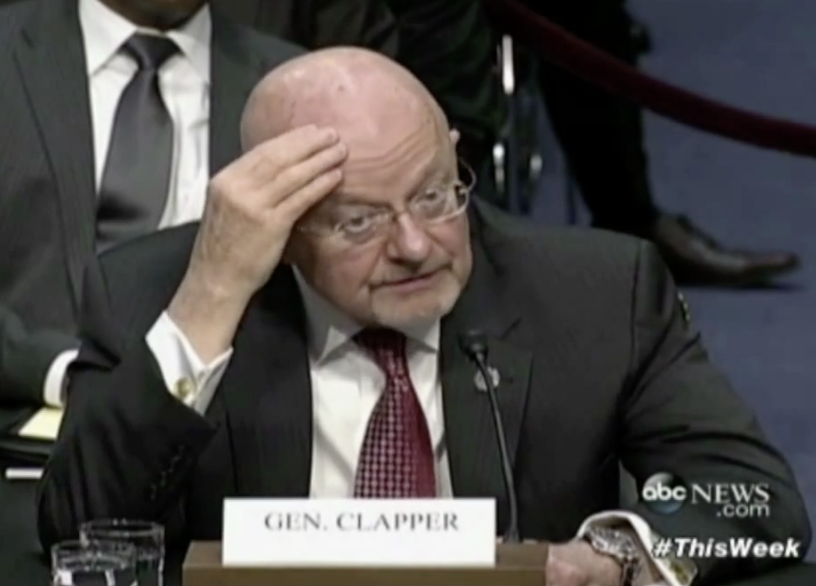
James Clapper
When former Senator Bob Graham—along with Rep. Walter Jones and Rep. Stephen Lynch—met with Director of National Intelligence James Clapper last week, Graham was surprised when Clapper suggested that the final move would be left to the Congress.
Graham told Carl Hulse of the New York Times, “No one has ever questioned that this is a decision that rests at the White House. The idea of adding another elongated, contentious step to the process is befuddling.”
When Dan Christensen of FloridaBulldog.org first broke the story of Clapper’s confusing comments, some observers interpreted that as possibly referring to a vote of the House or Senate intelligence committees. However, Graham says Clapper hinted at a scenario far more worrisome to transparency advocates. Wrote Hulse:
Mr. Graham said Mr. Clapper had compared the approach to the handling of a Senate report on C.I.A. torture of terror detainees. That document was reviewed by the Obama administration, which redacted parts of it over security concerns, and the Senate ultimately released an executive summary. But that was a messy process that took months of bitter fighting to resolve.
Responding to the Times story yesterday, the September 11th Advocates—a group of activist 9/11 widows—issued a two-page statement expressing alarm over the idea that the 28 pages could follow the same path as the torture report. In addition to expressing concern over the likelihood for delays, the group is also concerned about the idea that the final product would be a synopsis of the pages rather than full declassification: “Executive summaries are not meant to reveal facts or the truth— they are used to hide the facts and the truth. Thus, we find Clapper’s suggestion unacceptable.”
Reached yesterday by 28Pages.org, Rep. Jones seemed hopeful for a more straightforward White House recommendation to declassify the material, promptly followed by in a simple vote from the intelligence committees or the full House and Senate. “If President Obama says, ‘I recommend that we declassify the 28 pages,’ I don’t think it would take 10 minutes for the House and Senate to do it. There’s just too much American interest in this,” he said.
The September 11th Advocates claimed that the continued classification of the 28 pages violates the executive order that governs classification. Specifically, they noted that Executive Order 13526 forbids the use of classification to prevent embarrassment to a person, organization or agency, or to delay the release of information that does not require protection in the interest of national security—flawed rationales that have been alluded to by CIA Director John Brennan and the two chairmen of the 9/11 Commission.
A spokesperson for Clapper declined both a New York Times and 28Pages.org request to clarify his remarks to Graham: It looks like it will be up to the White House to provide the American people with a clear understanding of the declassification end-game.
Saudi Lobby on the Offensive
Saudi Arabia’s Glossy Counterterrorism Paper
Last week, Politico revealed that Saudi lobbyists were distributing a slick, 104-page white paper extolling the kingdom’s dedication to countering terrorism. Yesterday, The Hill’s Julian Hattem reported that the lobbyists’ collateral package had grown to include a 38-page prebuttal of the 28 pages, and that Saudi lobbyists are characterizing proponents of 28 pages declassification as “delving into conspiracy theories.”
That term is rarely used in serious discussions of the 28 pages, however it was central to a highly Saudi-friendly paper on the topic published last week by the Center for Strategic and International Studies—and then scathingly critiqued by 28Pages.org. CSIS accepts money from Saudi Arabia and a who’s who of defense companies that call the kingdom a customer.
We’ve obtained and posted both the Saudi white paper and 28 pages prebuttal so you can see precisely what the Saudis are selling.
House Hearing on Saudi Arabia and Counterterrorism
Yesterday, Texas Congressman Ted Poe chaired a hearing of a House foreign affairs subcommittee that focused on Saudi Arabia and counter-terrorism. (Archived video here.) A few highlights:
As The Intercept’s Alex Emmons reported, when the panel of witnesses was asked by California congressman and House Resolution 14 cosponsor Dana Rohrabacher if they believed “the royal family of Saudi Arabia did not know and was unaware that there was a terrorist plot being implemented that would result in an historic attack in the United States,” only two of the four raised their hands. One of the doubters was 9/11 Commission member Tim Roemer, who declared it too difficult a question to answer with a show of hands—perhaps owing to the vast size of the royal family.
Rohrabacher said, “We are intentionally ignoring who’s financing (terrorism). It’s clear to all of us…that the Saudis and the Saudi royal family have been right up to their eyeballs in terrorist activity and supporting the terrorist activity of radical Islamic forces in the Middle East.”
The panelists were uniform in their support of releasing the 28 pages. Roemer said, “The 9/11 families deserve it, the American people deserve it, and justice deserves it. We have a right to transparency and sunlight.”
Poe said he has read the 28 pages and supports their release, but is notably absent from the list of cosponsors of HRes 14.
Georgetown University’s Dan Byman said the biggest beneficiary of Saudi intervention in Yemen has been Al Qaeda in the Arabian Peninsula.
Rep. Brad Sherman said Saudi Arabia can’t claim to oppose terrorism while supporting extremism: “It’s time for Saudi Arabia to come clean.”
Rand Paul Working to Catch-Up with House Allies
Senator Paul, who last year introduced a bill with Sen. Ron Wyden that would direct the president to declassify the 28 pages, yesterday introduced an amendment to the National Defense Authorization Act that would do the same thing.
While a House resolution aimed at achieving the release of the pages has been steadily accumulating cosponsors—reaching 62 this morning—the Senate bill has inexplicably languished, even after 60 Minutes thrust the issue into nationwide headlines last month and a number of senators advocated their declassification.
New York’s Kristin Gillibrand was an original cosponsor of the Senate bill; in stark contrast to what House declassification leaders Walter Jones, Stephen Lynch and Thomas Massie have accomplished, Paul and Wyden have yet to persuade even one additional senator to officially sign on to a cause that has wide public support.
This is the second time Paul has pursued a 28 pages amendment to the NDAA. Last year’s amendment was not taken up for a vote.
Please call Congress today: Our easy guide makes is simple
On Thursday, the Center for Strategic and International Studies (CSIS) published a white paper and companion article ostensibly meant to furnish government decision-makers with an impartial analysis of what’s at stake in the potential declassification of 28 pages that are said to document indications of Saudi government ties to the 9/11 hijackers.
Instead, the 54-year old policy research organization furnished something entirely different: a case study in Saudi Arabian influence on the think tanks it finances.
A “Muscular Arm” of Foreign Government Lobbying
According to a 2014 New York Times expose that revealed a broad trend of foreign government funding of American think tanks, Saudi Arabia has given money to a variety of the institutions, including CSIS, the Atlantic Council, Brookings Institution and the Middle East Institute.
After coming under pressure for its lack of funding transparency, CSIS now lists donors on its website, which currently reflects the Oct 1 2014 through Sep 30 2015 fiscal year. While the government of Saudi Arabia is absent, the state-owned Saudi Aramco Services Company appears in the highest category of corporate donors.
Government donors to CSIS include the Saudi-allied United Arab Emirates and the United States. Just as significantly, CSIS receives money from a who’s who of defense contractors that profit from arms sales to the kingdom and have an interest in sustaining the close U.S.-Saudi relationship, including Lockheed Martin, Northrup Grumman, Boeing, General Dynamics, Raytheon, United Technologies, BAE Systems and L-3 Communications.
In their 2014 piece, New York Times writers Eric Lipton, Brooke Williams and Nicholas Confessore found that contributions from abroad are “increasingly transforming the once-staid think tank world into a muscular arm of foreign governments’ lobbying in Washington.”
The CSIS report—rich in praise for the Saudi monarchy while lacking even a single quote from any of the many credible champions of 28 pages declassification—lends enormous credence to their conclusion.
The paper was written by Anthony H. Cordesman. If that name rings a bell for 28Pages.org Blog subscribers, it may be because this isn’t the first time he’s served to exemplify Saudi-friendly think tank output.
Slanted from the Start
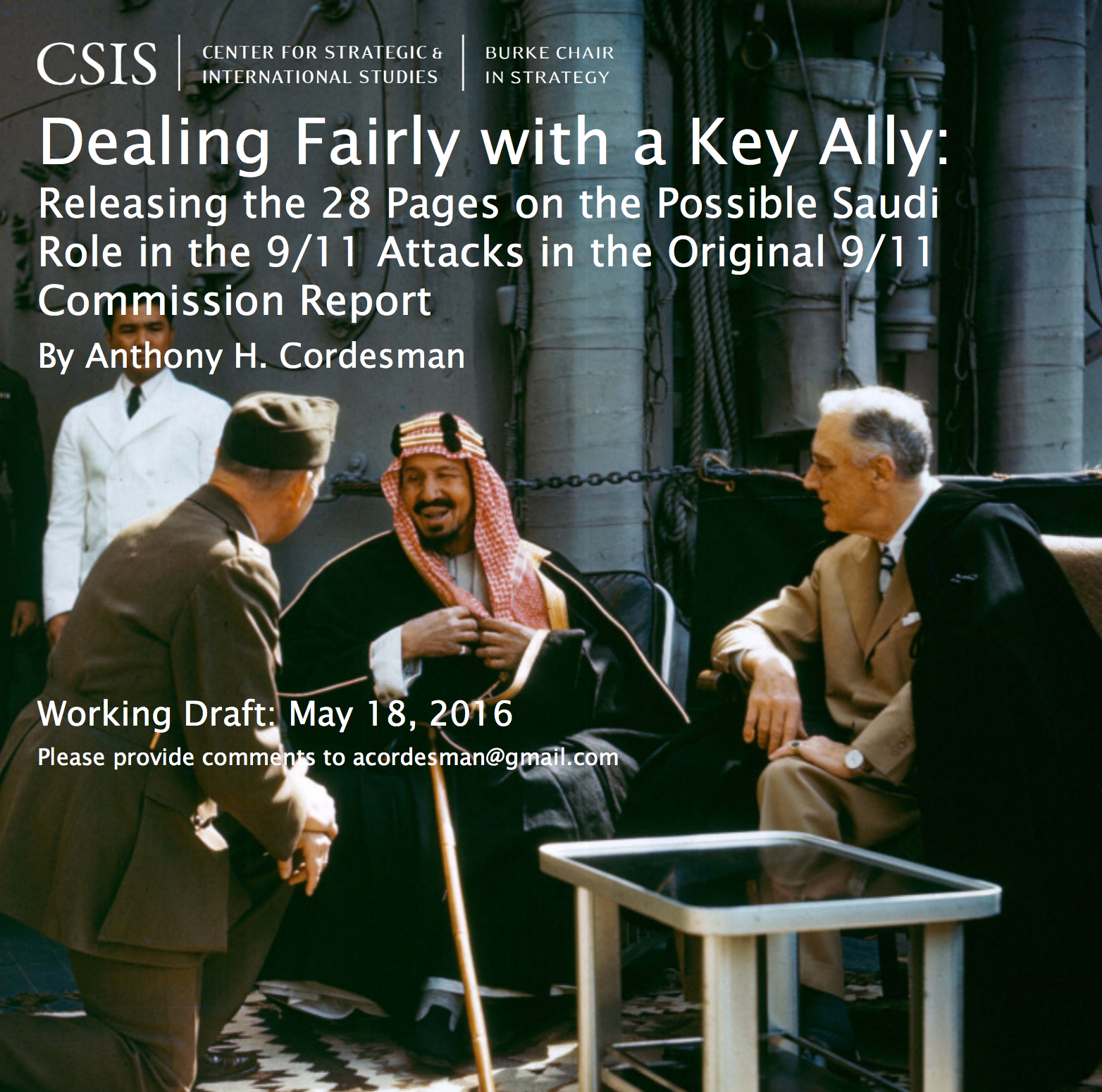
The title of his latest work—“Dealing Fairly with a Key Ally: Releasing 28 Pages on the Possible Saudi Role in the 9/11 Attacks in the Original 9/11 Commission Report”—simultaneously signals his slant and his sloppiness.
The slant: Cordesman’s overarching characterization of Saudi Arabia as a “key ally.” While a commonly-used label, it’s a dubious one given the kingdom’s long history of exporting extremism. More to the point, however, according to some who have read them, the 28 pages themselves offer proof that Saudi Arabia isn’t the “ally” it’s advertised to be. The release of the 28 pages could facilitate an evaluation of that label, but for Cordesman and the Saudi-funded CSIS, the ally status is an unquestionable, bedrock premise.
The slop: The 28 pages are in the report of a 2002 congressional intelligence inquiry into 9/11. Cordesman, however, repeatedly tells us they were produced by the “Original 9/11 Commission,” an entity that presumably preceded the 9/11 Commission, yet—like the notion of CSIS’s intellectual honesty regarding Saudi Arabia—is wholly imagined.
To be fair, the paper is labeled a “working draft.” While that disclaimer may suffice in overlooking the many copywriting errors found throughout the document, Cordesman’s slip on the simple foundational detail of the provenance of the 28 pages is just the first of many indicators of shallow and selective research on his part.
The errors of fact and form may be indicative of a CSIS rush to publish a Saudi-friendly analysis in a week in which the Senate passed a bill that would clear the way for 9/11 victims to sue the kingdom, and in which Director of National Intelligence James Clapper indicated his own portion of the declassification review was nearly complete.
High Praise for Saudi Arabia
Bodies of Executed Saudis Dangle Along With Their Separated Heads
Early on, Cordesman briefly, delicately and opaquely acknowledges that Saudi Arabia has “different values” from the United States and that “there are many areas where Saudi Arabia needs to make reforms.”
With that vague, check-the-box caveat out of the way, Cordesman plunges into typical form: “We also, however, have long shown that our two countries have more than enough common goals and values to be lasting strategic partners, both in military terms and in counterterrorism terms. We have seen that our partnership has been of great value to the United States, as well as to Saudi Arabia.”
The report is peppered with warm references to Saudi Arabia: “a major ally,” “a key ally,” “an important ally,” “a key partner in counterterrorism,” “a strategic partner,” “a key partner in both Gulf and regional security.”
There’s no questioning that Saudi Arabia and the United States have collaborated deeply. However, this collaboration—which has included joint sponsorship of Islamic extremism, the destabilization of Syria and a merciless attack on Yemen that benefits al-Qaeda—has been uniformly devastating to security and ultimately perilous to American lives at home and abroad.
In considering the “ally” label and the fruit of that “alliance,” we should all recognize that it’s possible for a foreign government to simultaneously be an ally of the American government and an adversary of the American people.
28 Pages of “Conspiracy Theories”
Cordesman acknowledges that he doesn’t know what’s in the 28 pages, but nonetheless presents his hunch that “much of the 28 pages consists largely of unvalidated charges and conspiracies.” Citing his years as director of intelligence assessment for the Secretary of Defense, he writes, “I learned all too well that (the Middle East) is a region that exports even more conspiracy theories than petroleum.”
Former Sen. Bob Graham
The “conspiracy theory” smear withers when you hear directly from the principal advocates of declassification. Apparently realizing that, Cordesman strikingly sidesteps any references to former Senate intelligence committee chairman Bob Graham, Rep. Walter Jones, Rep. Stephen Lynch, Rep. Thomas Massie and 9/11 Commission members John Lehman and Bob Kerrey.
While any impartial researcher of the 28 pages turns first to the statements made by those who have read them, they’re tellingly of no value to Cordesman. Thus, policymakers and journalists who consume the CSIS report never see remarks like these:
Lynch: The 28 pages “gave names of individuals and entities that I believe were complicit in the attacks on September 11. They were facilitators of those attacks. They are clearly identified…how people were financed, where they were housed, where the money was coming from, the conduits that were used and the connections between some of these individuals.”
Nor does Cordesman share this noteworthy claim by an anonymous government official: “We’re talking about a coordinated network that reaches right from the hijackers to multiple places in the Saudi government. If the 28 pages were to be made public, I have no question that the entire relationship with Saudi Arabia would change overnight.”
“No Idea” What Motivates Saudi Sponsorship of Extremism
With credible declassification advocates censored, Cordesman comfortably continues along his “conspiracy theory” line of attack.
In a clumsy pair of sentences that test one’s willingness to grant “working draft” mercy, Cordesman says “there is an amazing lack of discussion in any of the various media reports on those calling for release of the 28 pages regarding any clear motive on the part of the Saudi individual involved, much less any clear motive on the part of the Saudi government or Saudi Royal Family (sic). There is not only is no (sic) credible evidence of ‘who’, there is no credible mention of ‘why.'”
Cordesman wouldn’t have to search far to find quality analysis of the question of motive. In one of the most frequently-cited pieces on the 28 pages, Lawrence Wright in The New Yorker tidily sums up the why, and throws in the when and how as a bonus:
The theory behind the lawsuit against the Saudis goes back to the 1991 Gulf War. The presence of American troops in Saudi Arabia was a shattering event in the country’s history, calling into question the ancient bargain between the royal family and the Wahhabi clerics, whose blessing allows the Saud family to rule. In 1992, a group of the country’s most prominent religious leaders issued the Memorandum of Advice, which implicitly threatened a clerical coup. The royal family, shaken by the threat to its rule, accommodated most of the clerics’ demands, giving them more control over Saudi society. One of their directives called for the creation of a Ministry of Islamic Affairs, which would be given offices in Saudi embassies and consulates. As the journalist Philip Shenon writes, citing John Lehman, the former Secretary of the Navy and a 9/11 commissioner, “it was well-known in intelligence circles that the Islamic affairs office functioned as the Saudis’ ‘fifth column’ in support of Muslim extremists.”
There is of course no public precision on “who” is named in the 28 pages—after all, the “who” is likely the principal reason George W. Bush classified them. Congressman Jones insists the secrecy of the 28 pages isn’t for national security: “It’s about the Bush Administration and its relationship with the Saudis.”
An Agenda-Driven Report Right Down to a Sentimental Cover That Whispers: “A Marriage This Old Must Be Worth Saving”
Meanwhile, it’s public record that the wife of Prince Bandar bin Sultan—the Saudi ambassador to the United States during 9/11 and a close personal friend of Bush—wrote cashier’s checks that eventually found their way into the hands of apparent U.S.-based Saudi “handlers” of two future hijackers.
One could generously ascribe Cordesman’s proclaimed ignorance of “why” and potential “who’s” to a complete lack of research, but that would require believing that a 40-year veteran of Gulf security and terror study didn’t already encounter that information long ago.
Either way, Cordesman wants us to know he is completely baffled. The former national security assistant to Sen. John McCain writes, “I have to assume that there must be something more about motive in the 28 pages, but I have no idea what it could be.” All that’s missing from his flatly unbelievable and comically emphatic claim of ignorance is a trio of exclamation points.
An Echo Chamber of Government Stances
For the product of a “policy research organization” that has been crowned by the University of Pennsylvania as the world’s top think tank for international security, the paper cites a very narrow range of views. Over the course of 15 pages, Cordesman almost exclusively taps just three categories of sources:
His own wisdom
Official pronouncements of the Saudi government
Official pronouncements of the U.S. government
Apparently, Cordesman doesn’t recognize the particular pitfall of relying on government pronouncements when addressing an issue where the government has—through its very classification decision—explicitly indicated that it has something to hide.
For example, proclaiming his desire to move “beyond conspiracy theories,” Cordesman says he sought “more credible official data.” To that end, he cites a March 2015 report of the 9/11 Review Commission, which concluded that “there is no new information to date that would alter the original findings of the 9/11 Commission regarding the individuals responsible for the 9/11 attacks or for supporting those responsible for the attacks.”
Cordesman adds, “It is striking that the FBI report does not name any member of the Saudi royal family or senior Saudi official.”
DanChristensen
Though Cordesman would have the reader assume the 9/11 Review Commission’s report is deeply credible, FloridaBulldog.org’s Dan Christensen explains that the 9/11 Review Commission was an evaluation of the FBI that was managed by the FBI—the same FBI that failed to tell the congressional joint inquiry about its investigation of a wealthy Saudi family in Sarasota that suddenly fled the country two weeks before 9/11.
The FBI initially denied it held any records of that investigation. Under the duress of a Freedom of Information Act lawsuit, however, the FBI surrendered 80,000 pages of documents to a federal judge who is now painstakingly reviewing them for declassification.
Given the FBI has been a participant in what Graham called “a pervasive pattern of covering up the role of Saudi Arabia in 9/11, by all the agencies of the federal government which have access to information that might illuminate Saudi Arabia’s role in 9/11,” its published conclusions about any Saudi role in the attacks are deeply suspect.
They do, however, nicely serve the shared communications objectives of the Saudi monarchy, the U.S. government and, apparently, CSIS.
Policy Poison
If this paper had been produced by a Saudi-sympathetic journalist, it wouldn’t be cause for concern. However, the fact that it was published by an esteemed think tank that shapes the opinions of U.S. government officials and, by extension, American policy makes it truly alarming.
Remove the prestigious CSIS branding, and intelligent readers could be excused for guessing that this poorly researched, deeply biased and hastily-written piece was produced by a Saudi-owned entity.
Now that I think about it, I suppose they’d be right.
Call Your House Rep Today: Our Guide Makes It Easy
Congressman Thomas Massie, one of Capitol Hill’s leading advocates for the declassification of 28 pages said to link 9/11 to Saudi Arabia, used an appearance on CSPAN to make the case that releasing the pages would make Americans safer.
“I think keeping it secret jeopardizes national security,” Massie told CSPAN’s Greta Brawner on Wednesday.
The Kentucky congressman argued that hiding critical facts about the 9/11 attacks prevents the American people and their representatives from fully understanding the terror threat and adopting the right policies to counter it.
Massie decried the lack of professional curiosity his fellow legislators have demonstrated where the 28 pages are concerned.
“Frankly, most of my colleagues haven’t even read them. We are debating the National Defense Authorization Act this week which has policy implications for the Middle East. People voting on the NDAA this week have not read (the 28 pages), yet they’re crafting policy ostensibly to prevent another 9/11. Well, if you don’t know what caused the first 9/11, how are you going to prevent another one? So I think the argument about national security is an argument to release the 28 pages,” he said.
On Saturday, The Hill’s Julian Hattem reported that the congressional intelligence committees have seen a notable uptick in requests to read the 28 pages after an April 60 Minutes report thrust the topic into the national spotlight.
Since the 114th Congress convened in January 2015, 72 members have requested to read the pages. While that’s nearly triple the number who requested to read in the 113th Congress, it’s still low enough to confirm Massie’s claim that most of his peers are casting life-and-death national security votes in a fog of willful ignorance.
Support for Bill to Enable Suit Against Saudi Arabia
Earlier this week, the Senate passed the Justice Against Sponsors of Terror Act (JASTA), which would amend the Foreign Sovereign Immunities Act to enable 9/11 family members and victims to sue the Kingdom of Saudi Arabia for its alleged role in supporting the hijackers. The measure now goes to the House of Representatives.
Massie hadn’t seen the text of the Senate bill, but said, “I would probably vote for that. One of the arguments that I’ve made for releasing that report is so that you can discover the chain of culpability or liability for the victims. I’ve spoken with the families of the victims and the children of the victims and they really have no recourse right now and I think these 28 pages could help them.”
On Thursday, in an interview on RT America, Rep. Rick Nolan said the experience of reading the 28 pages made him “much more” supportive of JASTA and enabling 9/11 victims to sue those who enabled the attacks.
Massie’s Answer to a Frequent Declassification Question
Massie said he’s often asked why he doesn’t simply read the 28 pages on the floor of the House under the protection of the Constitution’s Speech or Debate Clause. “I don’t have a copy of it and they don’t let me take my cell phone (into the secure facility that houses the 28 pages)—and by the way, if I read it on the floor of the House they’ll never give me a secret document again,” he said.
Massie reaffirmed his commitment to bringing about the release through other avenues. “It may jeopardize relationships with other countries but so be it,” said Massie. “The truth needs to get out for the victims’ families and for our national policy.”
Call Congress: Our easy guide helps you make a quick impact
In an important development in the drive for greater 9/11 transparency, John Lehman, the former U.S. Navy secretary who served on the 9/11 Commission, has criticized recent statements by commission co-chairs Tom Kean and Lee Hamilton. The two had cast doubt on the reliability of 28 classified pages from a congressional intelligence inquiry and also said their commission had only identified one Saudi official as being implicated in aiding the hijackers.
Lehman’s statements appeared in a piece for The Guardian written by Philip Shenon, author of The Commission—the most exhaustive and revealing account of the 9/11 Commission’s work. Shenon wrote:
In the interview Wednesday, Lehman said Kean and Hamilton’s statement that only one Saudi goverment employee was “implicated” in supporting the hijackers in California and elsewhere was “a game of semantics” and that the commission had been aware of at least five Saudi government officials who were strongly suspected of involvement in the terrorists’ support network.
“They may not have been indicted, but they were certainly implicated,” he said. “There was an awful lot of circumstantial evidence.”
Lehman wasn’t the only commission member who spoke out via Shenon:
Another panel member, speaking of condition of anonymity for fear of offending the other nine, said the 28 pages should be released even though they could damage the commission’s legacy—“fairly or unfairly”—by suggesting lines of investigation involving the Saudi government that were pursued by Congress but never adequately explored by the commission.
“I think we were tough on the Saudis, but obviously not tough enough,” the commissioner said.
Shenon also reviews several indications that the commission’s pursuit of Saudi leads may have been thwarted—with specific references to the actions of commission executive director Philip Zelikow.
It’s a must-read; rather than fully summarizing it, we’ll instead urge you to read it all, and to also read our recent piece that makes the case that recent statements by Kean, Hamilton and Zelikow about the 28 pages are likely intended to guard their reputations against a truth that’s becoming more evident each day: The 9/11 Commission failed to vigorously examine potential Saudi ties to 9/11.
In other news today:
Three more members of Congress have cosponsored House Resolution 14, which urges the president to declassify the 28 pages: Brad Sherman (D, CA-30), Barbara Lee (CA-13) and Jackie Speier (CA-14). This new trio from the president’s own party brings the total to 52.
A story by Shane Harris at The Daily Beast dives deep into the mystery of the wealthy Saudi family that abrubtly left their Sarasota home just two weeks before the 9/11 attacks—but, according to some, not before having contacts with hijackers, including Mohammed Atta.
At Salon, Marcy Wheeler offers a new perspective on the NSA’s failures in the weeks leading up to 9/11, and the positively disturbing extent to which relationships with large government contractors influenced decisions and the drive for accountability.










 28Pages.org